Your balance sheet shows accumulated losses. Can you deduct the same amount from the next taxable profit? You must first reconstruct their origin, treatment and what has already been used. Reliable tracking does not fit into a single “remaining losses” cell. It tells the history of the file, year by year, and enables the new manager to find the evidence without starting again from scratch.
The framework to review
Carryforward is subject to conditions, including proper accounting records and the absence of prior use of the same loss. For financial years closed after 2016, the general framework covers the preceding seventeen financial years; losses from financial years closed between 1991 and 2016 remain without a time limit under the rules set out by the ACD. The oldest losses are used first. Carryback is not allowed under this framework. A transaction involving the company may require specific analysis.
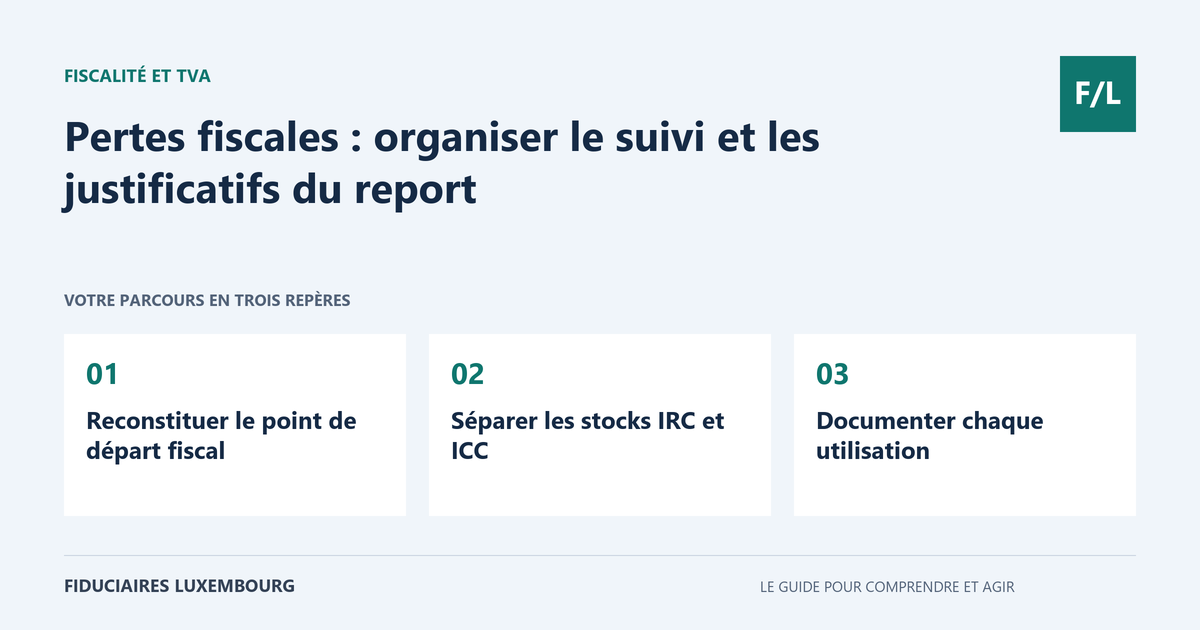
Reconstruct the tax starting point
Gather the accounts, tax returns and tax assessment documents for the financial years that generated the losses. For each of them, identify the accounting result and the tax adjustments. A non-deductible expense may alter the taxable result; therefore, the negative amount shown in the accounts does not in itself prove a carryforward tax loss of the same amount.
Mark the years whose treatment remains to be confirmed. Do not mix a preliminary calculation, a filed return and a position ultimately retained without indicating their status. If an old document is missing, look for it in the previous firm's file or the relevant archives. A rounded amount recalled from memory must not become a tax entitlement presented as certain.
Separate IRC and ICC stocks
The basis for ICC may differ from that for IRC. The circular on ICC losses explains that additions and deductions specific to this tax may even result in an outcome with a different sign. You should therefore keep two separate records where the data warrants it, without assuming they are permanently equal.
Use a comparable layout to facilitate review: origin, initial amount, offsets, corrections and balance. The guides on IRC and on calculating ICC help place these stocks in each tax file. A common formula may help with reconciliation, but the amounts and assumptions must remain identified.
Document each use
For each profitable financial year, record the offsets retained and their year of origin. Add the reference of the return and any changes resulting from the assessment. A discrepancy corrected several years after its origin must be reflected in subsequent balances; correcting only the last line could conceal excessive use in an intermediate year.
Keep previous versions of the table with a note explaining the correction. The person taking over the file must be able to understand why a stock has decreased. Loss tracking resembles a movement account: opening, use, correction and closing. You must never deduct a second time an amount already used in a previous return.
Monitor the period and changes in circumstances
Show the financial year of origin and the last financial year of use to be validated under the relevant rules. Do not replace this analysis with an expiry date calculated from the date the return was sent. A non-calendar financial year or a change in year-end requires verification. Explicitly distinguish older losses subject to a different regime.
Before an acquisition, merger, conversion or significant change in activity, provide the record to the adviser. The principle links the deduction to the party that incurred the loss, and specific or anti-abuse rules may apply. A loss-making company must therefore not be presented as a product automatically giving a purchaser a transferable tax saving.
Use tracking in forecasts with caution
The forecast must specify the expected profit and the losses whose use has been considered possible. Show uncertainties rather than systematically reducing future tax expense to zero. A tax possibility is not an immediate cash receipt. It does not finance wages or suppliers until the corresponding economic and tax conditions are met.
At year-end closing, reconcile the table with the tax calculations and any accounting presentation issues. Request a separate analysis before recognising a deferred tax asset: the existence of a tax stock is not sufficient to decide its accounting treatment. Finally, keep a usable copy of the tracking record among the documents provided to the manager.
The table to take action
| Column | Purpose | Supporting document |
|---|---|---|
| Tax and taxpayer | Avoid mixing items | File identification |
| Financial year of origin | Track age and period | Accounts and initial calculation |
| Amount retained | Distinguish estimate from tax position | Return and assessment |
| Uses | Avoid double deduction | Calculations for subsequent years |
| Balance and observations | Prepare the following financial year | Dated reconciliation |
A partially used loss does not disappear from tracking
Fictional example: a validated tax stock of EUR 45,000 is available under the applicable framework. An offset of EUR 18,000 is subsequently retained and documented. The balance of this stock is EUR 27,000, subject to the other carryforward conditions. The table must retain the origin of the EUR 45,000 and the reference for the use of the EUR 18,000. Deleting the first line to retain only EUR 27,000 would lose the seniority and evidence of the calculation. This example illustrates tracking; it does not demonstrate the eligibility of a particular loss.
Your preparation checklist
- Gather the financial years of origin.
- Reconcile the accounting and tax results.
- Separate taxpayers and taxes.
- Identify the status of the amounts retained.
- Track each use and correction.
- Verify the carryforward order and period.
- Flag restructurings before a decision is made.
- Provide the table and its supporting documents.
Frequently asked questions
Do accounting losses always correspond to tax losses?
No. Tax adjustments and prior uses may explain a difference.
Can the same stock be used twice in two financial years?
No. The record must show the offsets and the remaining balance, along with the corresponding documents.
Does an acquisition guarantee the availability of losses?
No. The file must be reviewed in light of the transaction, the activity and the applicable rules.
Useful terms in this guide
Questions to ask the professional
- Which documents prove the opening stock?
- Why do the IRC and ICC balances differ?
- Which changes could affect the intended use?
To clarify the engagement to be assigned, also see our taxation section.
And for your situation?
Prepare a historical table and the documents supporting each movement. Search our directory for a professional to verify the stock actually available and incorporate its possible use into your forecasts, without confusing tax entitlement with cash flow.
Sources and verification
References consulted on 20 September 2026. Official procedures specify the applicable conditions and exceptions.
This guide explains a general process. The applicable rules depend on your situation; it does not constitute personalised advice. Report a correction.
Your next step
A specific need deserves the right contact
Accounting, taxation, company formation or payroll: prepare your questions, then search the directory for the professional who can review your situation. Check their assignments and status before entrusting them with your file.