One day of teleworking per week may seem simple to arrange. For a cross-border employee, however, several calendars need to be considered: actual place of work, travel, contractual working time and the rules of the country of residence. The right approach is to separate tax and social security matters, then keep a shared record of the facts. This guide concerns ordinary private-sector salaried employment situations and helps you prepare an arrangement that can be verified.
The framework to check
Tax treaties and European social security rules have distinct objectives. The tax tolerances currently provided for residents of France, Belgium and Germany are 34 days, but their arrangements are not identical. The social framework agreement on teleworking may, subject to conditions and upon application, allow the legislation of the employer’s State to be maintained where teleworking in the State of residence accounts for at least 25% and less than 50%. The public sector and specific situations require separate analysis.
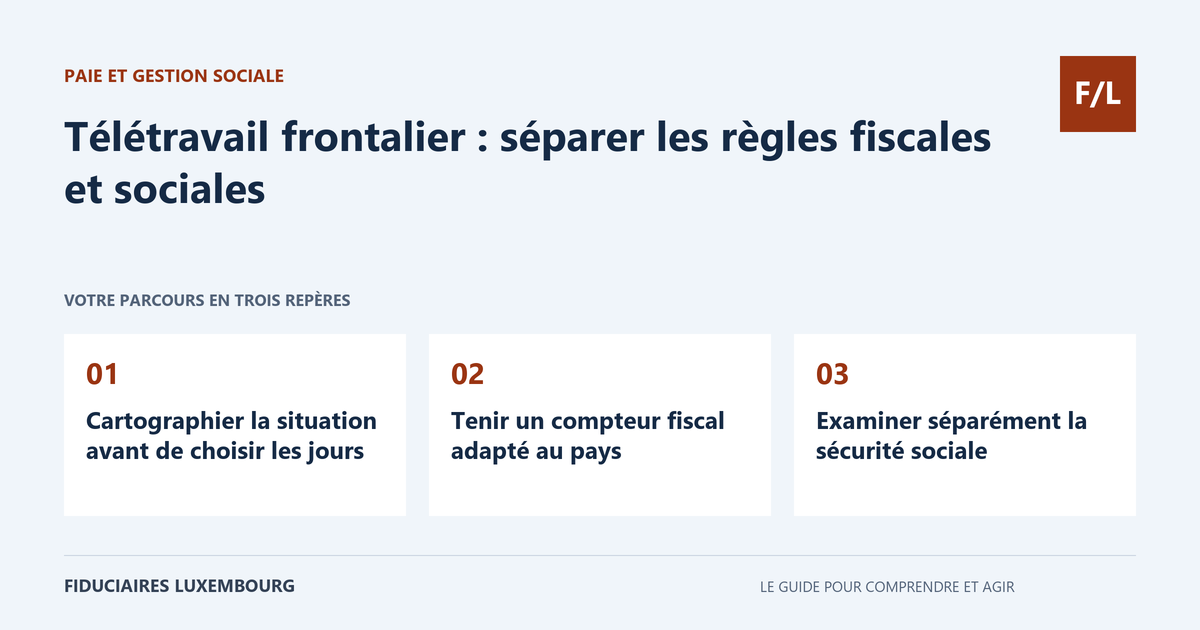
Map the situation before choosing the days
Record the country of residence, the employer or employers, the usual places of work, contractual working time and any activities in other countries. Tax residence must be assessed according to the relevant rules; an address used for correspondence does not necessarily settle this matter. A change of residence must be reported before carrying forward the previous schedule.
Also describe travel, training and work at clients’ premises. Tracking cannot be limited to the days marked as “teleworking” in the calendar. A day spent in a third country may affect the tax count or the social security analysis. Establish a channel for reporting these events to the person responsible for payroll.
Maintain a tax counter tailored to the country
For France, the ACD circular of 24 June 2026 specifies, in particular, the counting of fractions of a day and the proportional reduction of the threshold in the event of part-time work or an incomplete year, rounded down. Days worked outside Luxembourg must be reviewed, including certain training sessions or assignments. Therefore, do not automatically schedule 34 days for every employee.
For Germany, the circular of 18 March 2024 provides, on the contrary, for no pro rata adjustment linked to part-time work or an incomplete year; it notably uses a period of activity of at least 30 minutes for the relevant count. These arrangements must not be transposed to Belgium or France. Exceeding the threshold does not simply mean taxing only the excess days: the allocation of taxing rights must be reviewed under the applicable treaties.
Review social security separately
The framework presented by the CCSS concerns an employee and signatory States, subject to several cumulative conditions. Teleworking must, in particular, be carried out in the State of residence, with a connection to the employer’s working environment, and the situation must not involve the other usual activities excluded from the arrangement. A proportion within the specified range is therefore not sufficient on its own.
The requested maintenance must be formalised and the A1 certificate monitored. Outside this range, or where the conditions are not met, the ordinary rules for determining the applicable legislation must be reviewed. It should not be concluded either that coverage is automatically maintained in Luxembourg or that it is automatically transferred without analysing the facts.
Create a single record, then two reviews
Keep a dated record including country, duration, nature of the activity and any change to the schedule. Distinguish work, travel, training and absence so that the relevant persons can apply the correct treatment. The record must reflect the facts, with a correction procedure where the planned schedule has changed.
Based on these data, carry out a tax review by country and a social security review according to the framework adopted. The units and periods are not interchangeable. An alert should be triggered before the limit, taking into account travel already planned. An annual check after the final payroll is too late to calmly organise the next working days.
Link the work agreement to the declarations
Formalise the practical arrangements with the persons responsible for the employment contract, human resources and payroll. Specify the information to be reported, approvals and review frequency. The internal teleworking agreement replaces neither the tax review nor social security formalities. Our guide on the clauses to prepare for a permanent employment contract helps organise this file.
Monitor the certificate period and changes that may require a new procedure. Communicate the validated consequences in the payroll variables, then check that they have been taken into account. Keep a clear file for the employee: assumptions adopted, records, decisions and review dates. They must be able to understand to whom to report an additional assignment or a change of residence.
The table to take action
| Question | Tax | Social security |
|---|---|---|
| Subject | Right to tax remuneration | Applicable social security legislation |
| Reference point | Days and arrangements specific to the treaty | Proportion and conditions of the applicable framework |
| Elements | Country, duration, assignment, part-time work | Residence, employers, activities and allocation |
| Formalisation | Validated tax calculation and treatment | Application and A1 certificate depending on the situation |
| Review | Travel or risk of exceeding the threshold | Change in facts or expiry date |
The schedule must include training abroad
Fictional example: a company tracks only the teleworking days of an employee residing in France. Professional training organised outside Luxembourg is added to the schedule, but is not included in the counter. The manager then requests a complete record of working days and places, as well as contractual working time, in order to review the relevant tolerance. At the same time, they check whether this activity changes the conditions of the social security file. The decision does not consist of mechanically converting a number of days into a percentage: each framework is reviewed under its own rules before the next payroll.
Your preparation checklist
- Check residence, employers and usual locations.
- Distinguish private-sector employment and specific cases.
- Choose the tax rules of the country concerned.
- Include assignments and training in the analysis.
- Check social security conditions separately.
- Formalise the procedures and monitor the A1 certificate.
- Trigger alerts before the limits.
- Review the file whenever there is a significant change.
Frequently asked questions
Can 34 days be applied to all cross-border workers without adjustment?
No. The arrangements vary according to the treaty and the situation. France and Germany, in particular, do not follow the same pro rata adjustment rule.
Does the social security agreement automatically allow 49% teleworking without tax consequences?
No. Its conditions, the application and the social security file must be checked. It does not override tax rules.
Should only work from home be counted?
Tracking must include other relevant places of work and travel. Their effect is then analysed under each framework.
Useful terms in this guide
Questions to ask the professional
- Who maintains the record of the places actually worked from?
- Do our counters use the rules specific to each country?
- What event triggers a new analysis and an A1 procedure?
To clarify the assignment to be entrusted, also consult our payroll and social security administration file.
What about your situation?
Prepare the contract, the actual and planned schedule, the countries concerned and the available social security documents. Then search our directory for a professional experienced with cross-border teams to coordinate tax and social security checks with your work organisation.
Sources and verification
References consulted on 20 September 2026. Official procedures specify the applicable conditions and exceptions.
- ACD — questions fiscales des non-résidents
- ACD — circulaire France–Luxembourg du 24 juin 2026
- ACD — circulaire Allemagne–Luxembourg du 18 mars 2024
- CCSS — accord-cadre sur le télétravail
- CCSS — notice et exemples sur le télétravail
This guide explains a general process. The applicable rules depend on your situation; it does not constitute personalised advice. Report a correction.
Your next step
A specific need deserves the right contact
Accounting, taxation, company formation or payroll: prepare your questions, then search the directory for the professional who can review your situation. Check their assignments and status before entrusting them with your file.