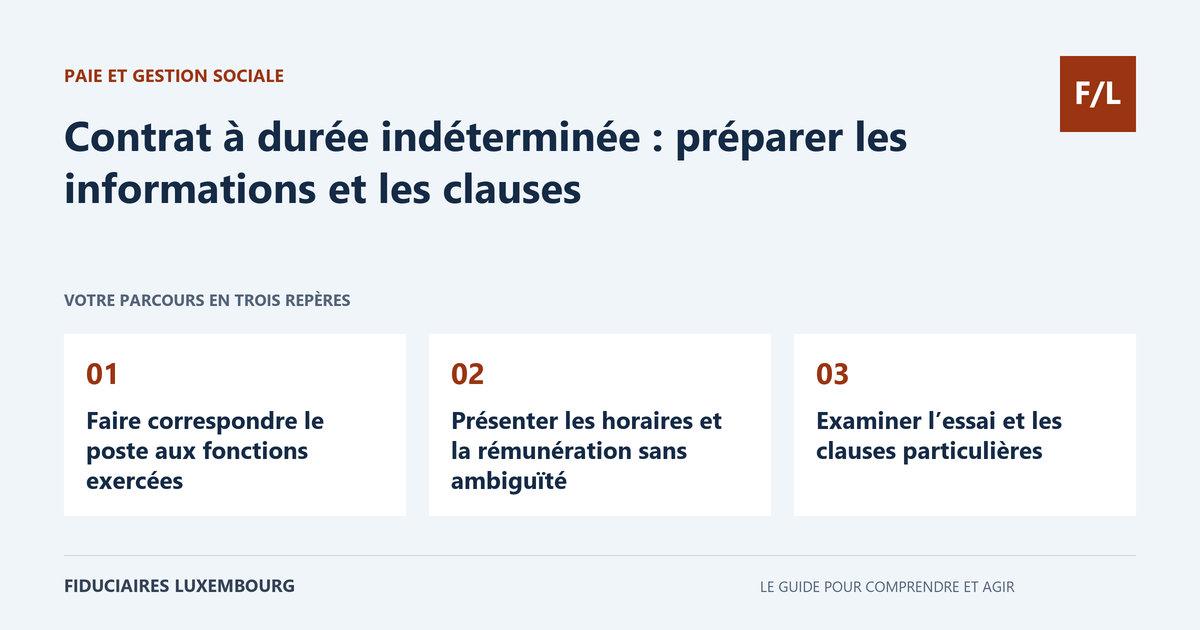
A clear contract is not only useful on the day it is signed. It becomes a reference for payroll, working hours, leave and discussions throughout the employment relationship. The right starting point is to describe the actual job, then check that the clauses reflect the same organisation. Here is how to prepare the elements to be reviewed before entering into an open-ended employment contract in Luxembourg.
The framework to check
An open-ended employment contract governs an employment relationship with no end date set in advance. The contract must contain the information provided for by the Labour Code, including that reinforced since 2024: remuneration conditions, termination procedures, social protection and the right to training where applicable. Some information may result from authorised references to applicable texts. Mandatory rules and collective agreements must be complied with; a signed clause is not automatically valid.
Matching the position to the duties performed
Describe the main tasks and responsibilities with a useful level of precision. A title such as “versatile employee” is not sufficient to explain a position involving sales, management or technical work. The description must also make it possible to check the applicable classification and collective conditions without confining every daily task to the contract.
Set out the place of work, expected travel and the intended arrangements for remote work. Do not present unlimited mobility as a mere formality. If several countries are involved, have their consequences reviewed before signature. The contract must be consistent with the reality, the declarations and the way the employee will be supervised.
Presenting working hours and remuneration unambiguously
Prepare the normal working time and its organisation, with relevant arrangements concerning overtime or shift work. Distinguish agreed working hours from a mere scheduling preference. For part-time work, have the required details and allocation checked. The information will subsequently be used for payroll and absence monitoring.
Separate base salary, supplements, bonuses and intended benefits. For a variable component, describe what triggers it and how it will be determined, then have the conditions reviewed. Avoid discussions in which an amount is sometimes presented as gross and sometimes as net. Check the applicable collective agreement and current salary parameters before finalising the figures.
Reviewing probation and specific clauses
If a probationary period is envisaged, have its duration, conditions and formalisation checked before the employee starts work. It is not automatic for every open-ended employment contract. Do not add afterwards a clause that is supposed to have existed from the first day. The timetable must allow questions to be addressed before the actual start of work.
Confidentiality, use of equipment, ownership of work or restrictions after departure may require specific review. First describe the concrete need that the clause seeks to address. Very broad wording may be unnecessary or unsuitable. Avoid copying a restriction from another country without checking its Luxembourg framework and conditions.
Checking all information and its consistency
Use the current ITM list as a checkpoint, then compare the contract, appendices and policies to which it refers. Statements concerning leave, termination, social protection and training must be reviewed as carefully as salary. An old template may appear complete while omitting information added since its creation.
Check that the references genuinely enable the employee to know the relevant rules. An announced but missing appendix or an untraceable policy undermines the clarity of the file. Identify the versions provided and the elements that fall under the contract, the law or an internal procedure. This distinction helps to understand how a change will need to be handled.
Linking signature to onboarding and payroll
Provide for a review by the persons concerned, followed by the conclusion and delivery of the document in accordance with the applicable rules. Check the dates and the identity of authorised signatories. Keep a complete, legible version. If a difference from the initial offer appears, clarify it before signature instead of allowing two contradictory promises to circulate.
Provide the useful information to the person responsible for the declaration of commencement and payroll. They must know the approved conditions, not only a draft received at the beginning of recruitment. Then monitor changes to duties, working hours and remuneration. Have it determined which changes require an agreement or specific formalisation before applying them.
The table for taking action
| Topic | Specific question | Gap to avoid |
|---|---|---|
| Duties | What work will actually be performed? | Vague title and very different tasks |
| Location | Where and in which countries? | Cross-border remote work not anticipated |
| Working time | What duration and what organisation? | Contradictory schedule and contract |
| Remuneration | Which components and under what conditions? | Oral bonus absent from the file |
| Probation | Is it provided for and compliant? | Clause added after the start date |
| Information | Which texts and appendices apply? | Reference to a document not provided |
A promised bonus, but impossible to calculate
Fictitious example: a company promises a sales bonus without specifying the sales included or the calculation period. The draft open-ended employment contract only repeats the word “bonus”. Before signature, the parties clarify the events taken into account and the available data, then have the wording reviewed. The payroll department receives the approved conditions and knows who will provide the results. The objective is not to multiply clauses: it is to make the promise understandable and applicable. A question resolved before the employee starts prevents the first disagreement from arising at the time of payment.
Your preparation checklist
- Describe the tasks, responsibilities and actual location.
- Check the classification and collective agreement.
- Specify the duration and organisation of work.
- Distinguish the remuneration components.
- Review any probationary period before the start date.
- Check the current mandatory information.
- Provide the relevant appendices and versions.
- Pass the final conditions on to payroll.
Frequently asked questions
Can an old template be used without reviewing it?
Its currency and suitability for the position must be checked. The required information and the company’s situation may have changed.
Does a probationary period exist automatically?
No. It must be provided for and comply with the applicable conditions. It must be addressed before the employee starts work.
Does signature make every clause valid?
No. Mandatory rules and validity conditions continue to apply, even when the document is signed.
Useful terms in this guide
Questions to ask the professional
- Which clauses are necessary for this specific position?
- Does the template take account of the information required since 2024?
- How will the conditions be transmitted to and monitored in payroll?
To define the assignment to be entrusted, also consult our payroll and social administration information page.
And for your situation?
Gather the offer, the job description and the policies to which the contract will need to refer. To coordinate its preparation with payroll, search our directory for a suitable professional, specifying whether you also need a legal review of the document.
Sources and verification
References consulted on 20 September 2026. Official procedures specify the applicable conditions and exceptions.
This guide explains a general process. The applicable rules depend on your situation; it does not constitute personalised advice. Report a correction.
Your next step
A specific need deserves the right contact
Accounting, taxation, company formation or payroll: prepare your questions, then search the directory for the professional who can review your situation. Check their assignments and status before entrusting them with your file.