You need someone for a few months. Is that enough to enter into a fixed-term employment contract? The envisaged duration does not answer the whole question. You must be able to explain why the task is temporary and check that the contract correctly reflects that need. Preparation work therefore starts with the facts, before choosing an end date or using a template.
The framework to check
The use of fixed-term employment contracts is regulated and must not permanently fill a position linked to normal and permanent activity. It must be drawn up in writing no later than when the employee starts work. The general regime provides for a maximum of two renewals and twenty-four months in total, with specific cases to be examined. The principle or conditions of renewal must be provided for in the initial contract or an amendment. The absence of a written agreement and failure to comply with the conditions may have significant consequences, including classification as an open-ended employment contract.
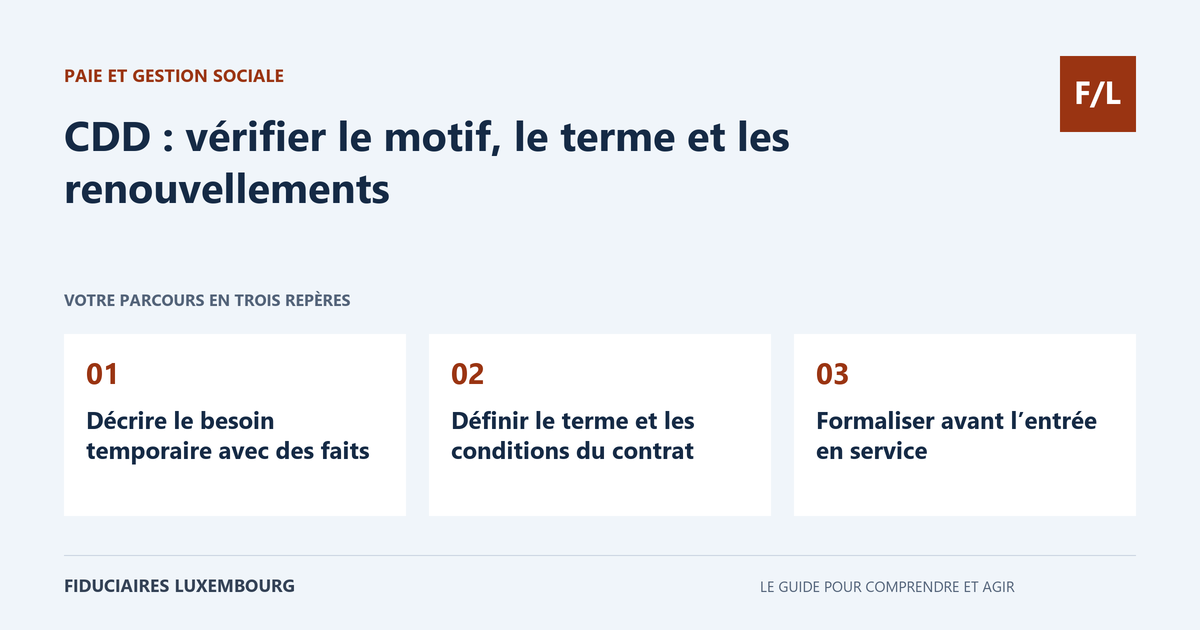
Describe the temporary need with facts
Explain what creates the need, what task must be carried out and why it is not permanent. A replacement, seasonal activity or a temporary increase in activity must be described according to their reality and the conditions of the applicable case. Do not simply write “need for flexibility”. The file must make it possible to link the reason and the assigned duties.
Keep the elements that explain the timetable without accumulating unnecessary personal information. For a replacement, distinguish the necessary professional identification from medical data that must not circulate in the recruitment file. If the position ultimately corresponds to a lasting need, have the choice of an open-ended employment contract reviewed instead of artificially adapting the narrative.
Define the term and the contract conditions
Have it determined whether the contract must include a precise end date or whether the case allows for a term linked to an event, with the necessary provisions. The foreseeable end of a commercial project is not automatically a legally suitable term. The wording must make the event understandable and prevent one party from depending on a decision left without a framework.
Also prepare the information common to every employment contract: duties, place of work, working hours, remuneration and applicable rules. The temporary nature does not exempt you from these elements. If a probationary period is provided for, have the limits specific to fixed-term employment contracts and its proportionality to the envisaged duration checked against the current rules.
Formalise before the start of employment
The signing schedule must precede the actual start of work. The ITM points out the consequences of the absence of a written agreement at the time of commencement: this is not a detail that can be erased by a backdated document. Allow time for review and for handling questions, then keep the executed version and appropriate proof of delivery.
Check that the person in charge of onboarding knows the validated dates and conditions. An employee must not start based on a simple announcement that “the contract will arrive tomorrow”. Also coordinate the declaration of commencement of employment and payroll preparation. The contract and the declared information must reflect the same commitment.
Reassess the reason before each renewal
Schedule a review sufficiently before the end date to decide based on current facts. Does the need still exist under the conditions justifying the fixed-term employment contract? Have the duties changed? How many renewals and what total duration have already been counted? Maintain a shared timeline rather than several contracts scattered across emails.
Have the required clause or amendment and the applicable regime checked. A maximum limit that has not been reached does not automatically authorise a renewal. Successive contracts and any intervals between them are a separate matter, to be examined before bringing back the same person or filling the same position. A new file name does not change the reality of the relationship.
Anticipate the end and administrative follow-up
As the end date approaches, specify the handover tasks, access rights and items to be returned. Ask the professional which steps and documents correspond to the end of the contract. Termination before the end date does not automatically follow the rules for an open-ended employment contract; it must be examined within its own framework. Do not give an instruction to leave solely on the basis of a notice period copied from elsewhere.
Provide final payroll variables, leave and other relevant elements together with their supporting documents. Have the consequences of continuing work after the end date checked rather than allowing the situation to continue without a decision. Keep a record of what was completed and of departure declarations, checking confirmations.
The table to take action
| Point | Question to document | Working document |
|---|---|---|
| Need | Why is this task temporary? | Factual description of the reason |
| Duration | What term corresponds to the case? | Schedule and planned event |
| Written agreement | Will the contract be entered into in time? | Final version and proof of delivery |
| Renewal | Does the reason still exist? | Timeline and updated assessment |
| End | What follow-up and what formalities? | Handover list for payroll |
A proposed renewal without reassessing the need
Fictional example: a company recruits to deal with a temporary increase in files. At the end date, it wishes to extend the contract because the employee is already familiar with the tools. However, preparation for the renewal reveals that the envisaged duties now correspond to the team's usual and lasting activity. The company has the form of the engagement reassessed before any signature. The right question was not only how many months remained available: it concerned the actual reason for the new need. This educational case does not decide an individual case, but shows the value of a review before each step.
Your preparation checklist
- Describe the task and its temporary nature.
- Check the authorised grounds for use.
- Determine the term and the provisions specific to fixed-term employment contracts.
- Have any probationary period reviewed.
- Enter into the written agreement before the actual start date.
- Keep a timeline of duration and renewals.
- Reassess the reason before an extension or successive contract.
- Prepare the end, payroll and corresponding declarations.
Frequently asked questions
Is a short contract necessarily a valid fixed-term employment contract?
No. The chosen duration does not replace the reason and the other legal conditions.
Can it be renewed as soon as some duration remains available?
The reason must still exist and the required formalisation must be observed. The maximum limit is only one part of the assessment.
Can a written agreement be regularised by dating it from the first day?
A document must not be backdated. An absence of a written agreement must be reported and its consequences examined based on the actual facts.
Useful terms in this guide
Questions to ask the professional
- Which authorised case exactly corresponds to the need?
- Which rules on terms and renewals apply?
- What should be anticipated if the need becomes permanent?
To clarify the assignment to be entrusted, also consult our payroll and social administration section.
And for your situation?
Prepare the description of the need and the full timeline of engagements. To coordinate the contract and payroll, search our directory for a suitable professional and request a legal review when the reason, renewal or end of the contract raises a difficulty.
Sources and verification
References consulted on 20 September 2026. Official procedures specify the applicable conditions and exceptions.
- ITM — cas de recours au CDD
- ITM — renouvellement du CDD
- ITM — absence d’écrit à l’entrée en service
- ITM — mentions du contrat de travail
This guide explains a general process. The applicable rules depend on your situation; it does not constitute personalised advice. Report a correction.
Your next step
A specific need deserves the right contact
Accounting, taxation, company formation or payroll: prepare your questions, then search the directory for the professional who can review your situation. Check their assignments and status before entrusting them with your file.