Has a firm or a bank asked you for documents relating to your company and its shareholders? The most useful approach is to understand the file to be prepared and the transmission channel, rather than sending sensitive documents without a framework.
The requested documents are used to understand identity, control and business activity. Registration with the RCS or the RBE does not exempt the professional from carrying out their own checks.
The framework to verify
Due diligence obligations apply to the professionals and situations provided for by the legal texts. Identifying the client, understanding the beneficial owner and assessing the source of funds are related but distinct steps. Registration in a register does not automatically replace the requested checks.
Explain who owns and controls the company
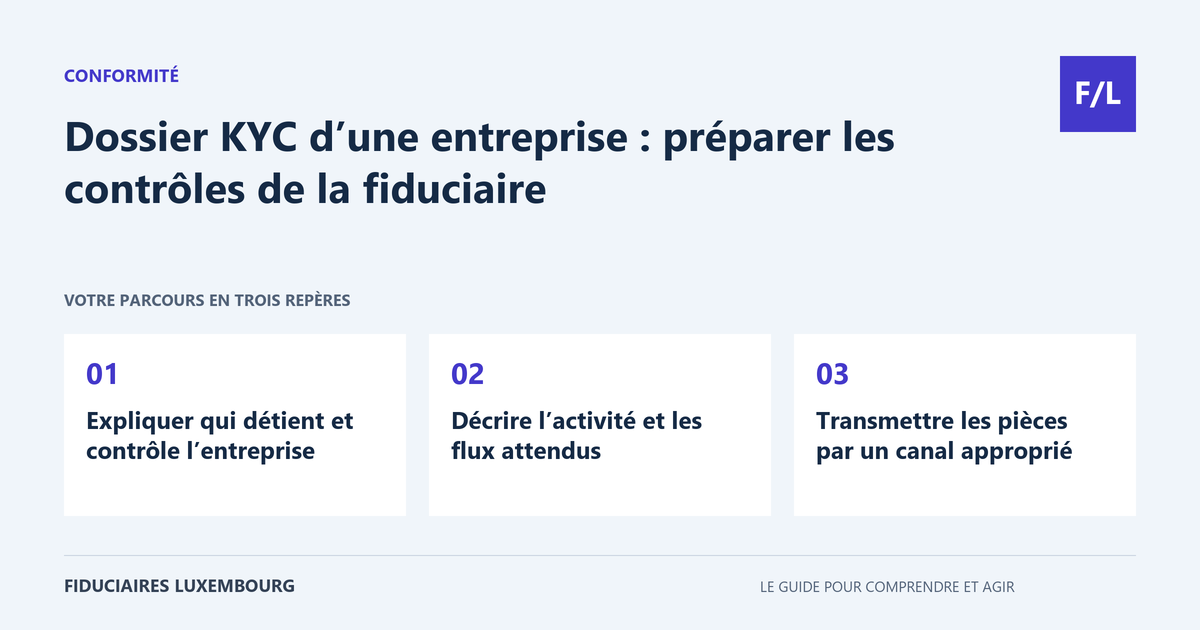
Prepare a dated organisation chart, the identity of intermediary companies and the information needed to trace back to the relevant natural persons. Simple direct ownership and a chain of foreign companies are not documented in the same way.
Declaration to the RBE follows its own rules. Check that relevant changes have been taken into account and keep the documents supporting the analysis. Do not equate a trading name with the legal identity of the contracting party.
Describe the business activity and expected flows
Present the products or services, countries, main types of clients and expected volumes. Explain the initial financing and unusual transactions. A business forecast, contracts and financial documents help align the project with the expected flows.
The required documents depend on the risk and the situation. Answer questions precisely and report any points that remain undetermined. The objective is not to obtain an automatic stamp of approval, but to enable the professional to understand the proposed relationship.
Send documents through an appropriate channel
Identity and financing supporting documents must be sent to the authorised recipient, through the channel agreed with them. Avoid sharing these documents through generic contact forms or with several intermediaries without knowing their role.
Keep a list of the documents sent and their dates, without multiplying unnecessary copies. Ask how to report a change in shareholding, business activity or authorised persons. A file that is accurate at the start of the relationship may become outdated.
Distinguish between a complete file and acceptance
Submitting all documents does not guarantee the opening of an account or the acceptance of an engagement. Each professional applies their own obligations and procedure. Include this step in the project timetable before announcing a start date.
If additional requests are made, centralise responses and correct inconsistencies between registers, contracts and the organisation chart. A documented explanation is preferable to an approximate response intended to artificially speed up processing.
Link each request to a document and an explanation
Classify the requests received by topic: legal identity, authorised persons, ownership and control, business activity, then financing. For each one, note the available document, its date and the question it addresses. One request may require several documents; conversely, sending a large file does not necessarily address the specific issue raised.
In a fictional example, a company receives an advance from its shareholder to purchase equipment. The shareholder's identity, the financing agreement and the bank transaction answer different questions. The professional may request additional elements suited to the file. The guide on the shareholder current account helps document the nature of the advance, without replacing due diligence review.
If the organisation chart includes several companies, date each level and identify the documents supporting the links. The RBE and beneficial owners guide explores this preparation in more detail. Report a difference between the registers and the recent situation rather than allowing the recipient to discover it without explanation.
Organise updates without multiplying copies
The CSSF describes a risk-based due diligence approach for professionals under its supervision. Requests are therefore not necessarily identical between two institutions or two transactions. This presentation does not mean that all fiduciaries fall under the CSSF: the framework and competent authority depend on the professional activity.
Designate a person within the company to coordinate responses and keep a record of the versions sent. Ask the recipient how to notify them of a change in director, control, business activity or country of operation. A useful review must cover the facts that have changed, not only the date of the last submission.
Verify the recipient and the channel before sending a sensitive document, particularly when a request comes from a new address. The guide on data exchanges with professionals helps frame such access. Our directory is used to find a contact; it does not need to receive your identity file in order to guide you. Keep the documents for the identified professional who will explain the scope of their request and the processing arrangements.
| Section | Documents to identify depending on the request | Event to report |
|---|---|---|
| Identity and powers | Extracts and representation documents | Appointment or change of signatory |
| Control | Organisation chart and proof of ownership | Transfer or change of control |
| Business activity | Contracts and description of flows | New market or unusual transaction |
| Financing | Documents explaining the resources | New financier or amended arrangement |
Let us look at a practical case
Fictional educational example, intended to explain the reasoning.
A company is owned by another foreign company. A simple extract from the first entity does not always make it possible to understand the persons who control it. The director prepares a dated organisation chart, identification information and the requested supporting documents. They clarify the missing documents and the secure means of sending them. If ownership subsequently changes, they know that an outdated file may require an update.
Points to prepare
- Legal identity and signing powers established.
- Organisation chart and beneficial owners documented.
- Business activity, financing and flows explained.
- Secure channel and file update arrangements agreed.
Frequently asked questions
Does the RBE replace the professional's check?
No. The register and the onboarding check are separate procedures.
Should identity documents be sent to the portal?
No, not for a simple request for guidance. Wait until an identified professional specifies the required supporting documents and the channel for sending them.
Useful terms in this guide
Questions to ask the professional
- Which documents address each request and as of what date?
- How should this sensitive information be transmitted and updated?
To clarify the scope of your request, also consult our guide on company formation.
And for your situation?
To prepare a relationship with a firm, first gather a presentation of the business activity and shareholding. Wait for its instructions before sending sensitive supporting documents through the channel it confirms. An initial contact should above all make it possible to clarify your needs. Search our directory for the professional suited to your needs, then ask them for an engagement and a detailed quote.
Sources and verification
References consulted on 20 September 2026. Official procedures specify the applicable conditions and exceptions.
- Guichet.lu — déclaration des bénéficiaires effectifs
- CSSF — lutte contre le blanchiment et le financement du terrorisme
This guide explains a general process. The applicable rules depend on your situation; it does not constitute personalised advice. Report a correction.
Your next step
A specific need deserves the right contact
Accounting, taxation, company formation or payroll: prepare your questions, then search the directory for the professional who can review your situation. Check their assignments and status before entrusting them with your file.