The SPF concerns the management of certain private assets. To determine whether it is worth considering, describe the investors, assets and planned transactions, without confusing it with a company intended for commercial activity.
Check the eligibility of investors and assets before examining taxation. An SPF and a commercial holding company do not have the same regime.
The framework to review
The SPF is a regulated regime, to be distinguished from the legal form selected and from the SOPARFI. Eligible investors, assets, activities and taxation must be reviewed. The term family does not by itself make it possible to infer the access conditions.
Defining the wealth management need
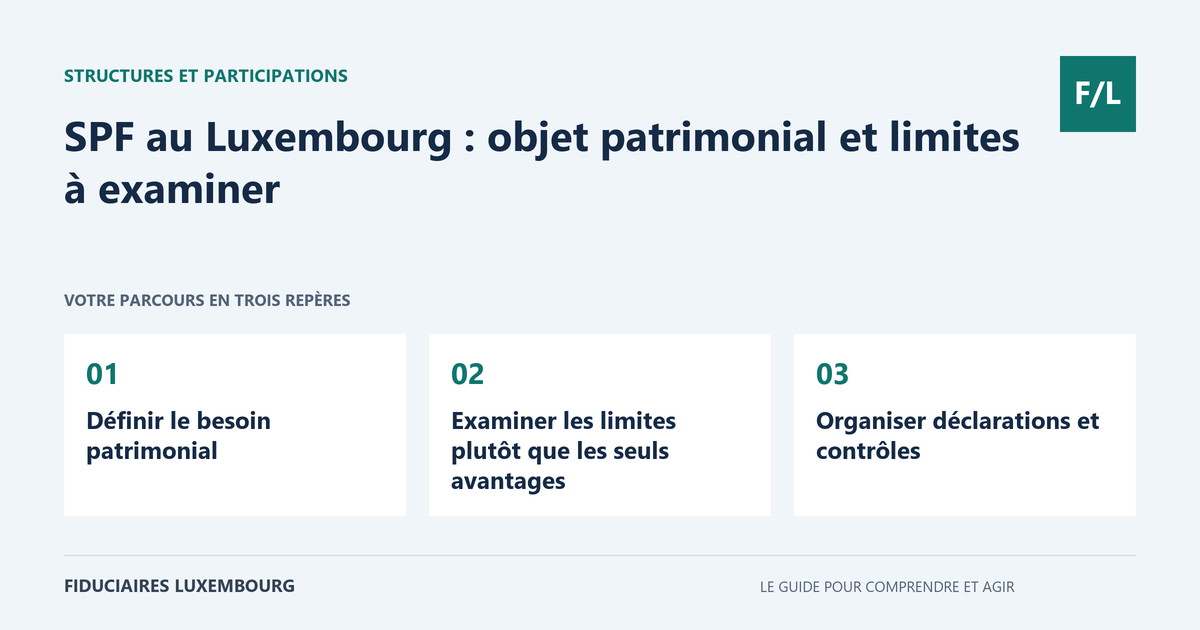
Describe the persons concerned, the assets, the expected flows and the holding objective. Distinguish between private wealth management, the carrying on of a commercial activity and collective management. The choice of structure must follow this classification.
The official page on subscription tax presents the SPF as a vehicle intended for private wealth management. The precise scope of eligible investors and transactions must be checked under the applicable legal framework, with specialised advice.
Reviewing the limits rather than only the advantages
Prepare a list of the contemplated assets and transactions: acquisitions, loans, shareholdings, distributions or sales. Have their compatibility with the purpose and restrictions of the regime confirmed. An activity permitted in a commercial company may not be permitted in an SPF.
Do not infer the tax treatment of its investors from that of the vehicle. The beneficiary's residence, distributions and foreign rules require separate analysis. A favourable outcome at one level is not sufficient to qualify the entire project.
Organising filings and checks
The subscription tax has its own filings and timetable. Guichet.lu describes a quarterly filing and payment for the entities concerned. Also check the certificates and information required for the SPF in their current version.
Assign responsibility for preparation, validation and payment. Keep evidence and document changes in investors or assets. A specialised regime requires ongoing monitoring of its conditions, not merely a review at the time of incorporation.
Comparing costs and alternatives
Estimate incorporation, administration, accounting, banking and advisory costs. Add the cost of changes and exit. Compare these amounts with direct holding or another structure suited to the need.
Request a written note specifying what is permitted, what is excluded and which events would require a new analysis. The firm's role is to make the operation understandable, without turning a tax feature into a general promise of savings.
Calculating the tax without confusing it with the cost of the vehicle
According to the AED's current presentation, the annual subscription tax for SPFs is 0.25%, with a minimum of EUR 1,000 and a maximum of EUR 125,000. The tax base includes paid-up capital, share premiums and the portion of debts taken into account on the first day of the financial year that exceeds eight times their total. Have the relevant data and variations checked for your filing.
The filing and payment are quarterly, with deadlines of 20 April, 20 July, 20 October and the following 20 January. The AED also states that an annual certification must be submitted electronically no later than 31 July. Organise the work of the competent signatory in advance: this certification is not limited to confirming that the tax has been paid.
These reference points, checked on 20 September 2026, do not constitute the full budget. Add fees, banking, formalities and transaction monitoring. Prepare an annual estimate and an exit cost. Any assumed savings must be compared with these charges as well as with the treatment of each investor in their country of residence.
Preparing a sheet for each contemplated investment
For each asset, describe its nature, how it will be held, the expected income and the planned transactions. A simple label such as “financial investment” does not sufficiently describe the rights and obligations under the contract. Attach the available documents and have compatibility with the regime analysed before acquisition, particularly for an unusual transaction.
Separate questions relating to the vehicle from those concerning the persons. An investor's eligibility, identification and the taxation of a payment are different analyses. The beneficial owner file helps document control; it does not replace the review of conditions specific to the SPF. A new entry into the share capital must trigger these checks before becoming a mere change in a table.
Finally, compare the SPF with other solutions based on your actual project. The SOPARFI guide explains another framework for holding shareholdings. Do not transpose its tax rules or activity possibilities to the SPF. Request a written comparison of permitted transactions, the required monitoring and the consequences upon a distribution or exit.
| Section | Information to gather | Question for the adviser |
|---|---|---|
| Investors | Identity, status and residence | Are they eligible and which rules apply specifically to them? |
| Assets | Contracts and planned transactions | Does the regime allow this holding and this use? |
| Financing | Capital, premiums and dated debts | Which tax base should be declared? |
| Monitoring | Timetable, signatory and supporting documents | Who prepares, certifies, files and pays? |
Let us consider a practical case
Fictitious educational example, intended to explain the reasoning.
A family holds a securities portfolio and is also considering a directly operated real estate investment. The two projects should not automatically be combined in the same structure. The professional first classifies the assets and activities, then examines the possible regimes, the investors and the consequences in their country of residence. This analysis may lead to separating the projects or choosing another arrangement, even if a single vehicle initially appeared simpler.
Points to prepare
- Wealth management objective and investors analysed.
- Eligible assets and transactions confirmed.
- Tax, filings and certificates monitored.
- Beneficiaries' taxation and full cost reviewed.
Frequently asked questions
Does an SPF replace a commercial company?
Not automatically. Its purpose and restrictions must be compatible with the contemplated transactions.
Does the taxation of the SPF settle that of the shareholders?
No. The situation of investors and distributions must be analysed separately, particularly abroad.
Useful terms in this guide
Questions to ask the professional
- Do our investors and assets meet the conditions?
- What consequences should be anticipated at the level of the structure and the investors?
To clarify the scope of your request, also consult our taxation section.
And for your situation?
Before selecting an SPF, compile the list of investors, assets and planned flows. Request specialised analysis covering both the vehicle's conditions, its operating costs and the beneficiaries' situation. Search our directory for the professional suited to your needs, then ask them for an engagement and a detailed quote.
Sources and verification
References consulted on 20 September 2026. Official procedures specify the applicable conditions and exceptions.
- Guichet.lu — taxe d’abonnement et SPF
- Guichet.lu — taxe d’abonnement et SPF
- AED — SPF, taxe et certification annuelle
This guide explains a general process. The applicable rules depend on your situation; it does not constitute personalised advice. Report a correction.
Your next step
A specific need deserves the right contact
Accounting, taxation, company formation or payroll: prepare your questions, then search the directory for the professional who can review your situation. Check their assignments and status before entrusting them with your file.