A real estate investment is assessed based on its actual cash flows: acquisition, financing, works, income and resale. The stated return is not enough to choose the ownership structure or assess the cash requirement.
Private ownership, professional activity and investment vehicles may be subject to different rules. VAT treatment must be examined separately from financing.
The framework to verify
Direct ownership and ownership through a company may have different consequences. The nature of the property, its use, location and the planned transactions notably influence taxes and VAT. A solution adopted for another property should not be replicated automatically.
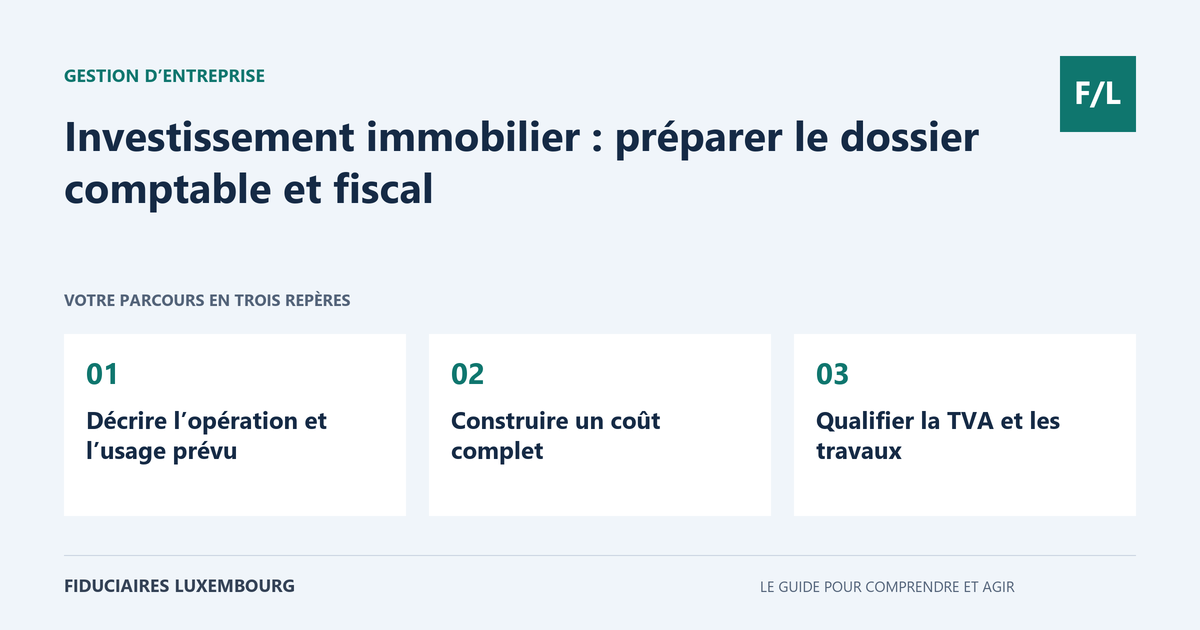
Describe the transaction and intended use
Specify who is acquiring the property, where it is located and what it is intended for: business use, letting or resale. Identify the works, potential vacancy and contractual constraints.
A company is not automatically the best ownership solution. Compare costs, governance, financing and exit. The analysis must cover the situation of the shareholders and any cross-border elements, not just the structure's tax rate.
Build up a full cost
Add acquisition costs, works, financing, insurance, maintenance, management and non-recoverable charges to the price. Distinguish firm assumptions from estimates. Calculate the expected result and cash position after repayment of the financing.
Test a period without a tenant, an increase in charges and additional works. Gross rent represents neither net income nor available cash. A cash reserve must be planned according to the project's risks.
Determine the VAT treatment and the works
Guichet.lu explains that certain property lettings or sales are exempt and that this may prevent the recovery of input VAT. The option possibilities and their conditions must be examined before adopting a recovery assumption.
Do not confuse the schemes applicable to housing with those applicable to a professional property. Have the treatment of each transaction, the works and changes in use clarified. An incorrect VAT assumption can significantly alter the actual cost of the project.
Organise monitoring during ownership
Keep deeds, loan agreements, leases, inventories of condition, invoices and statements. Track rents, unpaid amounts, security deposits and charges with regular reconciliations. Amounts collected on behalf of a third party are not necessarily income earned.
Also prepare for the disposal: technical documents, carrying value, remaining financing and tax consequences. The accounting firm monitors the accounts; the notary and specialist advisers are involved depending on the legal and tax aspects of the file.
Make the figures speak before comparing structures
Let us take a fictitious example without any tax assumptions: a property generates expected annual rental income of EUR 30,000. With EUR 5,000 in charges remaining at your expense and EUR 18,000 in annual financing repayments, EUR 7,000 remains before taxes and exceptional expenses. Two months of vacancy representing EUR 5,000 reduce this cash margin to EUR 2,000. Unexpected works of EUR 4,000 make it negative by EUR 2,000.
This cash flow calculation does not constitute the taxable result. In particular, the repaid capital portion and interest must be distinguished in the analysis; depreciation follows yet another logic. Therefore, provide the professional with the rental income, charges and loan schedule separately. The guide to fixed assets and depreciation helps explain the accounting monitoring of professional assets.
Add an exit scenario with the outstanding principal, costs and tax consequences to be examined. An expected increase in the resale price is not cash available to pay for works today. Keep a reserve suited to the identified risks and update the cash flow plan during phases of works or tenant changes.
Address VAT before finalising the works budget
The possibility of opting for VAT in real estate matters involves conditions and prior approval from the AED. The official page distinguishes, in particular, sale and letting transactions, the status of the parties and the use of the property. Therefore, do not automatically include all VAT on works as a recoverable receivable in your financing.
For a sale covered by the option, Guichet.lu states that approval must be obtained before the notarised deed. Have the sequence reviewed with the notary and tax adviser sufficiently early. For a letting, prepare the lease, the intended use and relevant information concerning the tenant's right to deduct. A change of use or occupant merits a new review.
Finally, keep estimates, amendments, invoices and proof of acceptance of the works in a shared file. Distinguish approved budgets from additional costs still under discussion. The guide on VAT deduction and mixed uses provides the basic questions, without replacing the real estate analysis of your transaction. The aim is to make every recovery assumption and every payment explainable.
| Item | Central scenario | Downside scenario |
|---|---|---|
| Income | Rents and realistic start date | Vacancy and late payment |
| Works | Estimates and VAT according to analysis | Additional costs and limited recovery |
| Financing | Instalments and guarantees | Delay, cost or additional needs |
| Exit | Estimated price, debt and costs | Delayed sale or lower price |
Let us move on to a concrete case
Fictitious educational example, intended to explain the reasoning.
An investor is hesitating between a rental dwelling and professional premises requiring works. They compare the price, but also periods without income, costs, loan conditions and tax treatments. They then prepare a delayed letting scenario and a resale scenario. The file enables the professional to discuss the structure and obligations based on the complete project, without promising a net return based solely on the advertised rent.
Points to prepare
- Owner, use and country identified.
- Full cost and vacancy scenarios calculated.
- VAT and works reviewed before commitment.
- Leases, charges and exit documented.
Frequently asked questions
Is gross yield enough to compare two properties?
No. Charges, works, financing, taxation and vacancy assumptions must be included.
Is VAT on works always recoverable?
No. It depends in particular on the transaction, use and applicable scheme; exemption may limit deduction.
Useful terms in this guide
Questions to ask the professional
- What full cost should be expected during works and periods without income?
- How do the rules differ depending on the use and structure?
To define the scope of your request, also consult our taxation section.
And for your situation?
Gather the draft deed, financing, estimates and intended use of the property before comparing structures. Request a coordinated analysis of cash flows, VAT and tax consequences, with the notary involved for the relevant deeds. Search our directory for the professional suited to your needs, then ask them for an engagement and a detailed quotation.
Sources and verification
References consulted on 20 September 2026. Official procedures specify the applicable conditions and exceptions.
- Guichet.lu — TVA et opérations immobilières
- Guichet.lu — acquisition ou location d’immobilisations
- Guichet.lu — sources et types de financement
This guide explains a general process. The applicable rules depend on your situation; it does not constitute personalised advice. Report a correction.
Your next step
A specific need deserves the right contact
Accounting, taxation, company formation or payroll: prepare your questions, then search the directory for the professional who can review your situation. Check their assignments and status before entrusting them with your file.