Receiving a dividend or disposing of a participation does not raise exactly the same tax question. To review the parent-subsidiary regime, start with the relevant flow and gather the characteristics of each company.
Do not infer the treatment of a transaction from the participation percentage alone. The relevant company, acquisition price, duration and other conditions also matter.
The framework to review
The conditions relating to the participation, holding period and eligibility of the companies must be assessed according to the income concerned. The exemption of dividends and that of capital gains are not interchangeable. Anti-abuse measures and cross-border rules must also be reviewed.
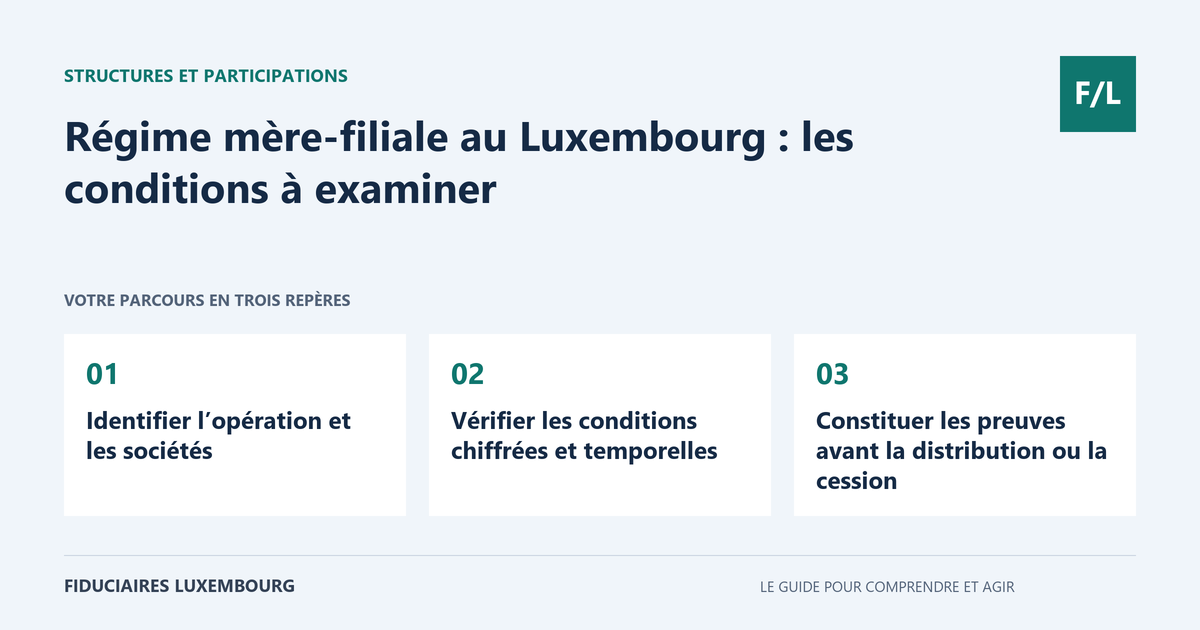
Identify the transaction and the companies
Map the flow: which company pays, which one receives, in which country and on what date? Determine whether it is a dividend, a disposal or other income. The treatment of an outgoing distribution must not be confused with that of a dividend received.
Gather information on the form, residence and tax regime of the companies. A holding company does not automatically benefit from the regime because it is classified as a SOPARFI. The analysis must be linked to the characteristics of each participation.
Verify the numerical and timing conditions
For participation income, Guichet.lu notably sets out a holding of at least 10 % or an acquisition price of at least EUR 1.2 million, subject to a holding condition or commitment over twelve months. For capital gains, the alternative acquisition price threshold is EUR 6 million.
These benchmarks do not summarise all conditions. Eligible entities, anti-abuse provisions, effects of deducted expenses and other restrictions must be reviewed. Keep a record of the timeline of acquisitions and changes in participation.
Compile evidence before the distribution or disposal
The file may include acquisition deeds, the securities register, cost supporting documents, distribution resolutions and evidence of tax residence. It must make it possible to understand how each condition was assessed.
Set out separately the expected Luxembourg treatment and the issues in the source country. A Luxembourg exemption does not guarantee the absence of foreign withholding tax. Reliance on a tax treaty may require its own supporting documents and procedures.
Ensure monitoring after the transaction
Prepare the returns and supporting documents that remain necessary even if the income benefits from an exemption. A non-taxed transaction is not necessarily an undeclared transaction.
Before an early sale or restructuring, have the consequences for holding commitments reviewed. Keep a dated position note and update it when a fact changes. The regime must be monitored throughout the life of the participation, not only at the time of its acquisition.
Compare the three questions on the same sheet
When the subsidiary pays a dividend, the treatment at source and that of the recipient company must be reviewed. When it is disposed of, the analysis concerns the capital gain and its history. These questions may involve different conditions. Therefore, prepare one line per flow, even if the companies are identical.
In a fictional example, a 5 % participation cost EUR 2 million. The price exceeds the alternative threshold of EUR 1.2 million used for dividends, but not that of EUR 6 million used for capital gains. This alone does not make it possible to conclude that the dividend is exempt: the duration, eligible entities and other conditions still need to be reviewed. The example only shows why a conclusion cannot be copied from one flow to another.
The guide to distributions and withholding taxes provides further details on formalities at the time of payment. The SOPARFI guide places the participation within the life of the company. These files complement each other; they do not create an automatic regime attached to a designation.
Keep the history that may affect the treatment
Gather the dates and costs of acquisition, percentage changes and holding commitments. Add the history of impairments and expenses related to the participation. Amounts deducted previously may affect the treatment of a disposal. The file must enable the tax adviser to reconstruct the relevant tax years without being limited to the latest balance sheet.
Where the comparable tax condition is relevant, use an up-to-date reference. Since tax year 2025, the ACD has indicated a reference of 8 %, linked to the 16 % corporate income tax rate, and also specifies that the rules for determining the tax base must be reviewed. The rate displayed in the foreign country therefore does not in itself constitute sufficient evidence.
Before a partial disposal, a change of residence or a restructuring, have the position note reviewed. The file for intra-group transactions helps document related flows, but addresses a separate analysis. Finally, identify the person responsible for forms, supporting documents and monitoring commitments: the absence of tax payable does not necessarily remove reporting obligations.
| Transaction | Tax question | Evidence to prepare |
|---|---|---|
| Dividend received | Exemption for the recipient | Holding, cost, duration and status of entities |
| Dividend paid | Withholding tax or exemption at source | Recipient, conditions and formalities |
| Disposal | Capital gain and tax history | Cost, duration, expenses and impairments |
| Cross-border flow | Rules of the relevant country and treaty | Residence, classification and local procedures |
Let us consider a practical case
Fictional educational example intended to explain the reasoning.
A company holds a participation and is considering both a distribution and a partial disposal. It cannot treat these two transactions as a single exemption request. It prepares the acquisition dates, costs, percentages and tax position of the entities. The professional reviews each transaction and the documents that will support the treatment. The decision is best made before the flows are carried out, when the consequences can still be incorporated into the timetable.
Points to prepare
- Flows and residence of the parties identified.
- Thresholds, duration and eligibility documented.
- Foreign withholding taxes reviewed separately.
- Returns and subsequent changes monitored.
Frequently asked questions
Is holding 10 % always sufficient?
No. The other conditions of the regime and those of the relevant flow must still be verified.
Are the thresholds for dividends and capital gains identical?
The alternative acquisition price threshold differs. The rules specific to the income being analysed must be used.
Useful terms in this guide
Questions to ask the professional
- Which conditions apply to this dividend and this disposal?
- What evidence should be retained during and after the holding period?
To clarify the scope of your request, also consult our taxation section.
And for your situation?
Before a distribution or sale of securities, gather the timeline of the participation and the tax documents of the companies concerned. Request a written analysis of each flow, the conditions to be maintained and the returns to be filed. Search our directory for the professional suited to your needs, then ask them for an engagement and a detailed quote.
Sources and verification
References consulted on 20 September 2026. Official procedures specify the applicable conditions and exceptions.
- Guichet.lu — régime des sociétés mères et filiales
- ACD — conventions fiscales internationales
- ACD — impôt correspondant à l’IRC
This guide explains a general process. The applicable rules depend on your situation; it does not constitute personalised advice. Report a correction.
Your next step
A specific need deserves the right contact
Accounting, taxation, company formation or payroll: prepare your questions, then search the directory for the professional who can review your situation. Check their assignments and status before entrusting them with your file.