The bank account appears comfortable today: will it be sufficient in six weeks? Cash flow monitoring answers this question by linking commitments to likely collection dates.
The current bank balance does not indicate what will be available after upcoming commitments. Show likely receipts and dated disbursements.
The framework to check
A cash flow pressure must be distinguished from a lasting difficulty and from situations that may entail specific legal obligations. Time extensions granted by a creditor must be confirmed. A cash flow forecast does not remove either a debt or a due date.
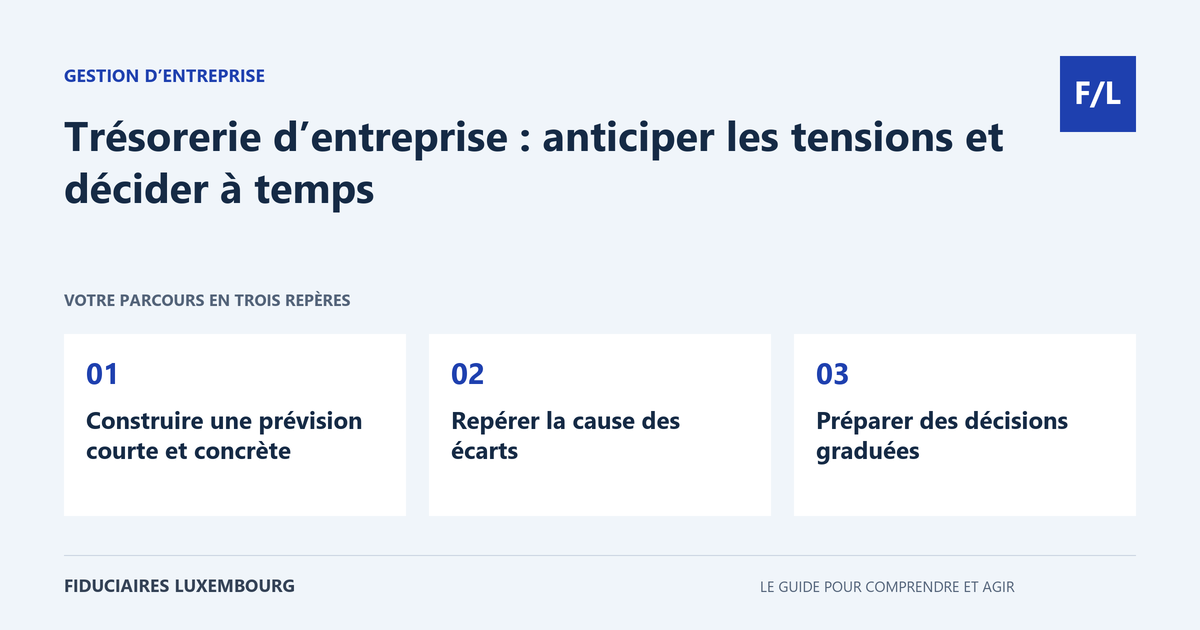
Building a short and practical forecast
Start with the available balance and list the payments expected over the coming weeks: suppliers, salaries, charges, taxes, financing and investments. Add receipts with their likely date, distinguishing between issued invoices and expected sales.
A simple forecast, updated each week, is more useful than a detailed model that is abandoned. Assign a source to each amount and flag uncertainties. The lines must not create a false impression of precision.
Identifying the cause of variances
Compare forecasts and actuals. A cash shortage may result from insufficient margins, late-paying customers, high inventory or investments made too quickly. Each cause calls for a different response.
Review old receivables and disputes. An invoice recorded in the accounts does not guarantee its collection. Also check debts not yet visible on the bank statement: committed orders, invoices to be received and tax due dates.
Preparing phased decisions
Identify expenses that can be deferred, follow-up possibilities and financing arrangements to discuss. Before changing a payment schedule, contact the other contracting party and formalise any agreement. Do not treat a deferral as granted.
Financing may help bridge a temporary gap, but by itself it does not correct a structurally loss-making activity. Present several scenarios with their cost and conditions. Have signs of serious difficulties reviewed promptly by competent professionals.
Linking cash flow and management
Share a clear table with the decision-makers: projected minimum amount, sensitive assumptions and necessary actions. The firm can help reconcile data and understand variances; the manager brings knowledge of contracts and customers.
After a cash flow pressure, adjust processes: faster invoicing, control of commitments or better tax forecasting. The objective is to turn the alert into a more reliable organisation, without waiting for the next emergency.
Distinguishing the signal, its cause and the decision
This guide concerns the decisions to make when facing a cash flow pressure. To build the table week by week, use our method for a thirteen-week forecast. Once the low point is visible, return to the causes: customer delay, increased inventory, insufficient margin or exceptional commitment. Several causes may accumulate, and their solutions are not interchangeable.
Take a fictional example: the plan shows a shortfall of EUR 18,000 in three weeks. A customer invoice of EUR 12,000 is overdue and an expense of EUR 8,000 may possibly be deferred. On paper, these two avenues would cover the shortfall, but neither is secure without collection or a confirmed agreement. The decision table must retain a scenario in which they do not materialise.
The aged receivables report helps organise follow-ups. It does not turn a disputed receivable into available cash. Ask what is blocking payment: a missing document, commercial disagreement, administrative processing or the customer's difficulty. Adapt the action and record the response rather than moving the same expected date every week.
Organising a short meeting focused on actions
Bring together the people who know the sales, purchases and payments. Present the projected minimum balance, the assumptions that affect it and the decisions needed before the next review. For each action, note a responsible person, an internal date and the expected evidence. The next meeting starts with new facts, not with an unexplained new version of the table.
If the pressure returns despite normalised payment terms, examine profitability. The break-even point makes it possible to discuss volumes, prices and fixed costs. Budget variance monitoring helps determine whether a drift comes from quantities, costs or timing. A loan may finance a need; it also adds its own due dates.
When the situation deteriorates, promptly prepare the available accounts, overdue debts, commitments and requests received. Have the legal consequences reviewed with a competent professional. Do not wait for a perfect forecast to request this review. The manager must be able to distinguish between management measures still available and obligations arising from the company's actual situation.
| Signal | Analysis to carry out | Evidence to monitor |
|---|---|---|
| Late-paying customer | Cause and disputed nature of the receivable | Payment or documented commitment |
| Rising inventory | Turnover, purchases and slow-moving products | Clearance plan and adjusted orders |
| Declining margin | Prices, variable costs and sales mix | Quantified measure and observed result |
| Due date impossible to cover | Available resources and options to examine | Formalised agreement or decision by the competent body |
Let us look at a practical case
Fictional educational example intended to explain the reasoning.
A profitable company is awaiting payment from a major customer while salaries and suppliers become due. It builds a short forecast, separates certain payments from uncertain receipts and prepares follow-ups. It then discusses options with its firm and financiers, without assuming that a deferral has been granted. After resolution, it reviews its invoicing terms and customer monitoring. The incident becomes an opportunity to improve a procedure, not merely to obtain a one-off advance.
Points to prepare
- Dated receipts and payments.
- Identified uncertain assumptions.
- Variances and causes analysed.
- Decisions and agreements monitored.
Frequently asked questions
Can a profitable company lack cash flow?
Yes. Payment terms, inventory and investments may create a financing need despite an accounting profit.
Does a loan solve all difficulties?
No. A temporary gap must be distinguished from a lasting profitability or financing problem.
Useful terms in this guide
Questions to ask the professional
- What is causing the cash flow low point?
- What actions can we take before the critical due date?
To clarify the scope of your request, also consult our accounting section.
And for your situation?
If a due date becomes difficult to cover, prepare the cash flow table and the list of debts before the meeting. A professional can help you distinguish the causes, discuss scenarios and identify legal questions requiring prompt intervention. Search our directory for the professional suited to your needs, then ask them for an engagement and a detailed quote.
Sources and verification
References consulted on 20 September 2026. Official procedures specify the applicable conditions and exceptions.
- Guichet.lu — business plan et prévisions financières
- Guichet.lu — sources et types de financement
- Guichet.lu — outils de financement de la SNCI
This guide explains a general process. The applicable rules depend on your situation; it does not constitute personalised advice. Report a correction.
Your next step
A specific need deserves the right contact
Accounting, taxation, company formation or payroll: prepare your questions, then search the directory for the professional who can review your situation. Check their assignments and status before entrusting them with your file.