A company car raises several questions at once: financing, expenses, private use, payroll and taxation. To compare options, keep a single reference situation and detail the assumptions.
The leasing payment is not automatically the value of the benefit in kind. Request a payroll simulation based on the regime applicable to your vehicle.
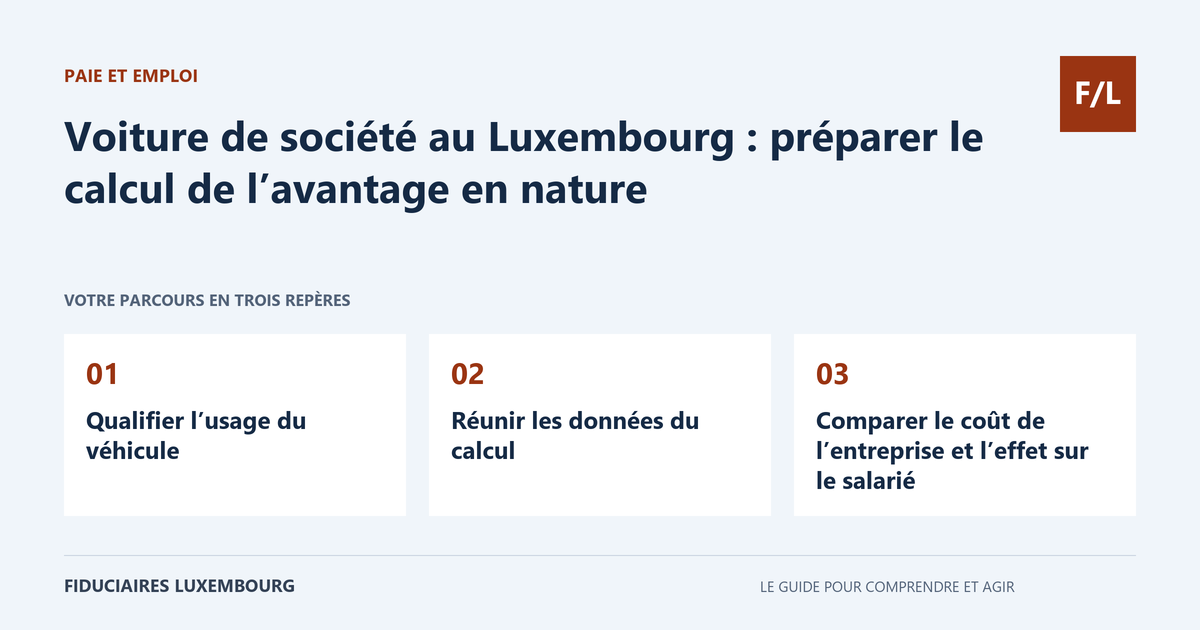
The framework to check
The benefit in kind, the deductibility of expenses and VAT treatment follow separate rules. The acquisition method, vehicle characteristics, dates and use may be relevant. An amount found for another vehicle or another period is not sufficient.
Define the vehicle's use
Describe the authorised professional and private uses, the beneficiary and the return arrangements. Private use of a car made available to an employee may give rise to a benefit subject to wage taxation and social security contributions.
Formalise the rules in a policy or vehicle availability agreement: maintenance, fuel, charging, authorised drivers, incidents and end of contract. The treatment of an executive or a cross-border situation requires an appropriate review.
Gather the calculation data
Provide the invoice or acquisition data, options, discounts, technical characteristics and relevant dates. Regimes may distinguish between powertrain, emissions or application periods. Check the current version of official guidance before ordering a vehicle.
Do not reuse a historical percentage without checking its conditions. Have the method, calculation basis and treatment of a personal contribution specified. An employee contribution does not necessarily have the same effect depending on its nature.
Compare the company's cost and the effect on the employee
Employer cost includes more than the monthly payment: insurance, maintenance, energy, taxation and any charges. For the employee, the economic cost depends on the payroll effect, their contribution and the expenses that remain at their expense.
Request a comparison based on identical assumptions between the vehicles under consideration. Present separately the annual cost for the company and the variation in the beneficiary's net pay. A simulation should state its validity period and assumptions, without promising a universal net amount.
Plan for the buy-back and the end of availability
A buy-back by the employee at a price below market value may constitute an additional benefit. The residual price under the leasing contract is therefore not sufficient to establish the tax treatment.
Upon return, update payroll, insurance and commitments. Keep proof of value and agreements. This closure prevents a benefit from continuing to be recorded when the vehicle is no longer available.
Read the regime in light of the vehicle's dates
Keep the order, contract and registration certificate together. The date of the commercial simulation does not replace these documents. Add the certified technical characteristics, as two vehicles with similar names may fall under different parameters.
In January 2025, the ACD announced the extension of favourable transitional rates for fully electric or hydrogen-powered cars registered until 31 December 2026. This reference point is not sufficient to set the rate for each case: request application of the text to your characteristics and dates, as well as a review of transitional provisions where the contract and registration belong to different periods.
For an existing fleet, keep a calculation sheet for each vehicle and beneficiary. Report changes in use, availability or personal contribution to the person preparing payroll. The review of monthly variables must include these events.
Compare two offers over the same duration
In a fictional management example, a monthly payment of 500 €, insurance of 80 € and an energy provision of 120 € represent 700 € per month, or 8 400 € per year. This addition constitutes neither the taxable benefit nor the final cost after taxation. It helps make assumptions visible before adding maintenance, any charges, the initial payment and return fees.
Also request a second comparison for the employee: effect of the benefit in payroll, personal contribution and expenses still to be paid. Net pay depends on their situation and the applicable calculation. Compare offers with the same mileage, duration and services, then explain the differences rather than showing only the lowest monthly payment.
Also prepare for end events: employee departure, contract interruption, return and any buy-back. Specify the agreements and supporting documents required before the decision. The forecast budget must distinguish recurring expenses from one-off payments. The VAT file retains its own review of use and the right to deduct. This separation helps the executive and the beneficiary understand what each amount represents.
| Amount | What it measures | Working document |
|---|---|---|
| Vehicle expenses | Company payments | Offer, contract and full budget |
| Benefit in kind | Value used for private use | Dated calculation and vehicle documents |
| Effect on net pay | Consequence in the employee's payroll | Personalised simulation |
| Buy-back price | Payment to acquire the vehicle | Agreement and justification of value |
Let's move on to a concrete case
Fictional educational example intended to explain the reasoning.
A company is hesitating between purchasing a vehicle and leasing it. It compares payments, but must also know the authorised private use, covered expenses and return conditions. For the employee, it requests a dated payroll simulation; for the company, a full budget. The two results are not the same. A clear agreement on use and expenses then helps apply the selected treatment consistently.
Points to prepare
- Documented use and beneficiary.
- Technical data and dates provided to payroll.
- Simulation method and assumptions explained.
- Return and any buy-back planned.
Frequently asked questions
Is an electric car always free from taxable benefit?
No. Treatment depends on the applicable rules, characteristics and dates. Check the regime in force for the vehicle being considered.
Is the leasing buy-back price necessarily the tax value?
No. The market value and rules applicable to the employee's buy-back must be reviewed.
Useful terms in this guide
Questions to ask the professional
- Which payroll simulation corresponds to the vehicle and the period?
- What expenses, limits and supporting documents should be planned for private use?
To clarify the scope of your request, also consult our payroll and social administration file.
And for your situation?
Before signing, gather the offer, the vehicle characteristics and the planned dates. Have separate payroll simulation and employer budget prepared, then clarify in writing the conditions of use and the end of availability. Search our directory for the professional suited to your needs, then ask them for an engagement and a detailed quote.
Sources and verification
References consulted on 20 September 2026. Official procedures specify the applicable conditions and exceptions.
- Guichet.lu — voiture de société et avantage en nature
- ACD — prolongation du régime des voitures électriques et à hydrogène
This guide explains a general process. The applicable rules depend on your situation; it does not constitute personalised advice. Report a correction.
Your next step
A specific need deserves the right contact
Accounting, taxation, company formation or payroll: prepare your questions, then search the directory for the professional who can review your situation. Check their assignments and status before entrusting them with your file.