A VAT return may sometimes appear to be just a form to complete. However, the decisive work takes place before submission: understanding the transactions, locating the documents and explaining the amounts. Here is how to build this file without confusing the obligations.
Do not confuse periodic returns, annual returns, recapitulative statements and Intrastat. Their purposes, conditions and deadlines differ.
The framework to check
Frequency depends on the applicable regime. Territoriality determines where a transaction is taxable, while the right to deduct determines under which conditions input VAT may be recovered. A technically accepted filing does not settle these substantive matters.
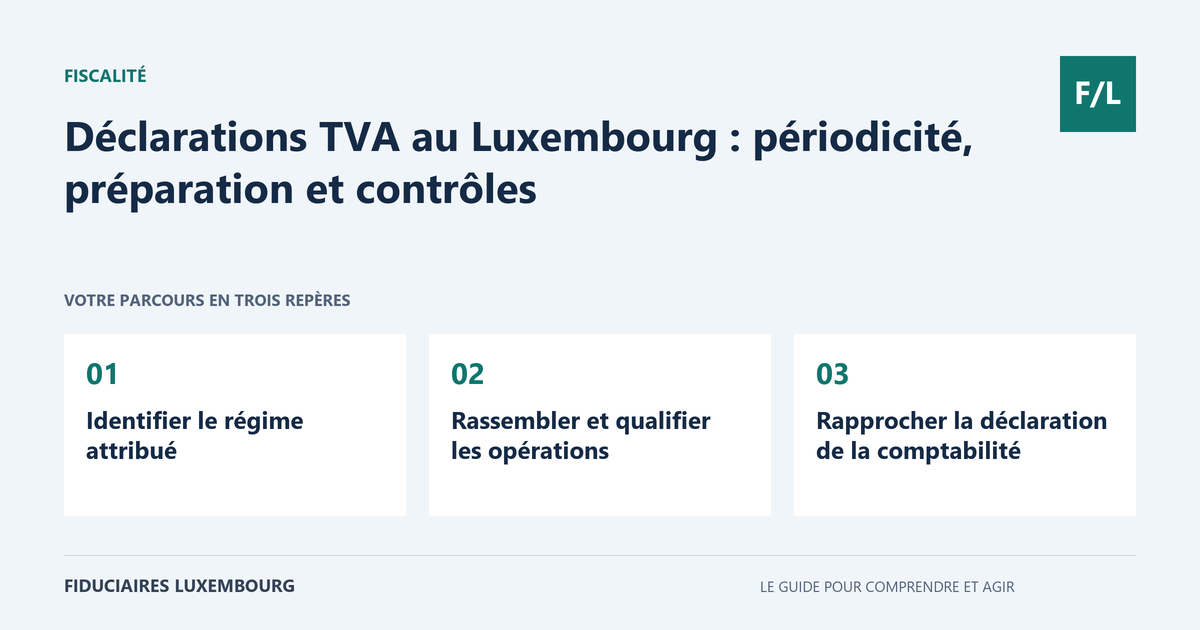
Identify the assigned regime
Keep the AED notification and check the frequency applicable to the business. The thresholds of €112,000 and €620,000 concern annual turnover excluding tax or the total of intra-Community acquisitions of goods and intra-Community supplies of services received, in accordance with the AED's frequency rules. Therefore, do not rely solely on your sales. The administration may adjust the frequency; keep its notification and have the applicable regime confirmed.
Monitor changes in the business activity and report relevant changes to the firm. The regime should not be inferred solely from the latest invoice or from an old turnover forecast. Also check the annual obligations associated with the regime.
Collect and classify transactions
Prepare sales, purchases, credit notes, imports and transactions with foreign countries. Distinguish the document date, the relevant period and the payment where these factors affect the treatment.
Check the parties' details, rates, special statements and supporting documents. Exempt, reverse-charge or transactions located in another country may require specific classification. An invoice without VAT is not necessarily a transaction without reporting obligations.
Reconcile the return with the accounts
Compare the taxable amounts and tax amounts with the accounts and journals. Identify discrepancies: missing invoices, duplicates, corrections or period differences. Document their resolution before validation.
The amount payable or the VAT credit must be explained. VAT recovery depends on the right to deduct and the documents, not solely on the existence of an expense. Where there are mixed activities, request an analysis of the relevant restrictions and adjustments.
File, pay and retain evidence
Electronic filing and payment are two separate operations. Check the tool, authorisations and deadlines for the relevant regime. Keep the filed version, acknowledgement and proof of payment.
For a correction, retain a record of the initial version and the changes. Technical acceptance of the file does not prove that each treatment is tax compliant. Prepare the supporting file to respond to a subsequent request.
Handle cross-border obligations separately
VAT recapitulative statements concern certain intra-EU transactions. Intrastat is a statistical collection of trade in goods, with its own conditions. One obligation must not be presented as the other.
For each foreign flow, ask the firm to identify the returns concerned and the evidence required. This mapping is particularly useful when entering a new market, starting online sales or changing the logistics chain.
Turn the return into a file that can be explained
For each period, start from a closed set of data: sales, purchases, credit notes and cross-border transactions. Keep the list of missing documents and their treatment. An invoice found after filing should not be discreetly added to the file already validated: identify the period concerned and have the correction to be made reviewed. The guide on credit notes and corrective invoices explains how to preserve the audit trail.
Then compare the declared taxable amounts with the accounts. A discrepancy may be justified by a tax point rule, a particular transaction or a correction; it must be explainable. Do not correct a total simply to make it match another table. Keep a dated reconciliation, the explanations and the name of the person who validated sensitive points.
Finally, distinguish filing from payment. Archive the acknowledgement of receipt, then check that the payment has been made using the appropriate reference and period. Where a return shows a credit, do not assume that it will be immediately refunded or offset against another debt: check the applicable treatment with your contact.
European transactions require several checks
A sale of goods to another Member State is not treated in the same way as a supply of services. For goods, the VAT number and transport evidence form part of the file to be reviewed. For services, start with the customer's status and the nature of the service before concluding that a reverse charge applies.
Recapitulative statements and Intrastat each have their own scope. They are not replaced by the VAT return. Prepare a matrix of obligations based on your actual transactions and have their frequency confirmed. Where there are private and professional expenses, also document the allocation before determining the deductible VAT. This organisation provides a useful basis if the administration subsequently requests explanations.
| Section | What you collect | Validation question |
|---|---|---|
| Sales | Invoices, credit notes and classification of transactions | Are the taxable amount, rate and period consistent? |
| Purchases | Invoices and evidence of professional use | Has the right to deduct been established? |
| European trade | Customer identification, transport or nature of the service | Which additional returns must be prepared? |
| Filing and payment | Acknowledgement of receipt and proof of payment | Are the correct period and reference being used? |
Let us consider a practical case
Fictitious educational example, intended to explain the reasoning.
A business invoices Luxembourg customers and also supplies services to a business established in another Member State. It cannot mechanically apply the treatment of its local sales to all its invoices. It gathers the nature of the services, the customers' status and the supporting documents, then has each flow classified. After validation, it separately tracks the filing of the return, any recapitulative statements and payment. It retains a record of each of these actions.
Points to prepare
- AED notification and available deadlines.
- Sales, purchases and foreign transactions classified.
- Return reconciled with the accounts.
- Filing and payment monitored separately.
Frequently asked questions
Is payment alone sufficient?
No. Filing and payment are separate obligations. Keep evidence of each.
Are recapitulative statements Intrastat?
No. The former fall under VAT; Intrastat serves a statistical purpose concerning trade in goods.
Useful terms in this guide
Questions to ask the professional
- Which flows require specific classification?
- Who checks the return and who initiates payment?
To clarify the scope of your request, also consult our tax section.
And for your situation?
To have your VAT organisation reviewed, prepare an example of a sale and purchase for each type of transaction, your latest returns and the list of uncertain points. You can request a specific engagement: initial classification, periodic preparation or a review of your controls. Search our directory for the professional suited to your needs, then ask them for an engagement and a detailed quote.
Sources and verification
References consulted on 20 September 2026. Official procedures specify the applicable conditions and exceptions.
- Guichet.lu — déclarations TVA
- Guichet.lu — taxe sur la valeur ajoutée
- STATEC — redevables de l’information statistique Intrastat
- AED — déclarations de TVA, cessation en cours d’année
This guide explains a general process. The applicable rules depend on your situation; it does not constitute personalised advice. Report a correction.
Your next step
A specific need deserves the right contact
Accounting, taxation, company formation or payroll: prepare your questions, then search the directory for the professional who can review your situation. Check their assignments and status before entrusting them with your file.