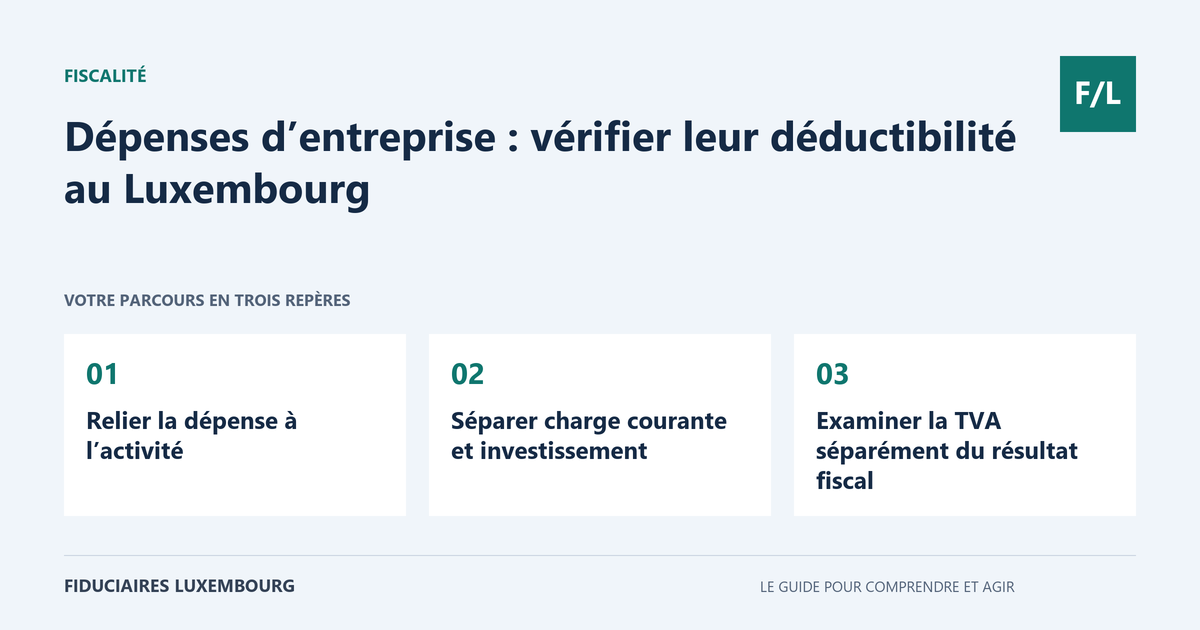
An expense that is useful to your business does not automatically receive the tax treatment you expect. To review it, start from its reality: who benefits from it, what is it for and what documents make it possible to explain it?
Distinguish between the business expense, the fixed asset, private use and recoverable VAT. These classifications may lead to different treatments for the same payment.
The framework to review
An accounting expense, a tax-deductible expense, a fixed asset and recoverable VAT are separate classifications. Their treatment depends in particular on the structure, use and applicable rules. Mixed expenses must be documented without treating all business use as a full deduction.
Linking the expense to the business activity
Keep an identifiable invoice and explain the connection with the business operations. Proof of payment proves settlement, but does not always describe the service or its business purpose. For unusual expenses, add a contract, an assignment note or an explanation of the context.
A director's personal expenses do not become business expenses because they are paid through the company's bank account. Where use is mixed, document the allocation adopted and have its treatment confirmed. Do not automatically apply the rules of a sole proprietorship to a company limited by shares.
Separating current expenses and investments
The purchase of a durable asset may qualify as a fixed asset and involve depreciation rather than an immediate deduction. The official source on the acquisition or rental of fixed assets explains this distinction and the consequences of the method of financing.
Describe the date it is put into service, the cost, related expenses and expected use. Compare purchase, rental and leasing based on their total cost and their accounting, tax and cash-flow effects. The lowest monthly payment is not enough to determine the best solution.
Reviewing VAT separately from taxable profit
An invoice may be recorded in the accounts without all of its VAT being deductible. VAT registration status, the use of the purchase and applicable limitations must be reviewed. Keep supporting documents that make it possible to link the purchase to the business's transactions.
Where there are exempt activities, foreign transactions or private use, request a specific analysis. The word “business” on a purchase does not resolve either territoriality or deduction restrictions.
Preparing a review of sensitive expenses
Before closing, isolate vehicle expenses, travel, meals, gifts, expenses paid by shareholders and invoices from related companies. For each item, state the amount, beneficiary, purpose and documents. This review makes the firm's questions easier to address.
Tax incentives or aid are not a general category of deductible expenses. They have their own criteria and supporting documents. Request a calculation setting out the rule applied and its limits, rather than a general promise of optimisation.
Creating a file for expenses that require an explanation
For a sensitive expense, note the purchaser, beneficiary, business purpose and period. Add the invoice, any contract and proof of payment. If a shareholder advanced the money, identify this payment to avoid recording the cost twice when it is reimbursed.
Expense claims must make it possible to understand the travel or purchase. A very general description may require further information. Expenses of a related company also require a review of the services actually provided; the transfer pricing file helps prepare the economic justification.
For mixed use, keep the information explaining the allocation adopted and changes during the year. The guide to VAT on mixed expenses covers the VAT aspect, which must remain separate from the treatment of taxable profit.
Understanding the effect over time before buying
An immediate payment may relate to an asset used over several years. In a simplified educational example, equipment costing €6,000 depreciated on a straight-line basis over three years produces annual depreciation of €2,000, assuming a full year and no residual value. The period and method are calculation assumptions here, not a tax rule applicable to all equipment.
The fixed asset register retains the cost, date put into service and movements. The year-end closing file links depreciation and other expenses to the correct period. Ask for significant tax adjustments to be explained separately from the accounting classification.
Before making a significant expense, compare the actual need, cash flow and treatment over time. Spending solely to reduce profit may weaken liquidity without improving the business. Have the remaining cost and required financing calculated, with explicit assumptions. If the business is making a loss, do not present the tax effect as immediately received savings: monitoring losses carried forward is a separate issue. You can then decide based on the service provided by the purchase, and subsequently understand its accounting and tax effect.
| Question | Required information | Treatment to review |
|---|---|---|
| Why this expense? | Purpose and beneficiary | Connection with the business activity |
| How long will it be used for? | Nature and use of the asset | Expense or fixed asset |
| Is there private use? | Documented allocation | Consequences for the company and beneficiary |
| Is the VAT recoverable? | Invoice, activity and use | Right to deduct and limitations |
Let us consider a practical case
Fictional educational example intended to explain the reasoning.
A director buys a computer used for the business and occasionally for private purposes. The invoice alone does not answer all the questions: the purchaser, use and relevant accounting and tax rules must be known. The firm then reviews the classification, the timing of recognition and any VAT. This approach avoids treating every bank outflow as an immediately deductible expense and mixing a company expense with a personal benefit.
Points to prepare
- Detailed connection with the business activity and supporting document.
- Private or mixed use identified.
- Expense and fixed asset distinguished.
- Tax deductibility and VAT recovery reviewed separately.
Frequently asked questions
Is an expense without an invoice always lost?
Treatment depends on the nature of the transaction and the evidence available. Find the supporting document and have the file reviewed; a bank statement alone may be insufficient.
Is a deductible expense free?
No. It remains a cost and a cash outflow; its potential tax effect depends on the regime and the business's circumstances.
Useful terms in this guide
Questions to ask the professional
- What documents support the business purpose of this expense?
- Should accounting, tax and VAT treatment be distinguished?
To clarify the scope of your request, also consult our taxation section.
And for your situation?
Gather unusual expenses before closing and explain their use. Request a separate assessment of the cost, its accounting timing, tax treatment and VAT in order to decide based on understandable figures. Search our directory for the professional suited to your needs, then ask them for an engagement and a detailed quote.
Sources and verification
References consulted on 20 September 2026. Official procedures specify the applicable conditions and exceptions.
- Guichet.lu — résultat d’exploitation et dépenses professionnelles
- Guichet.lu — acquisition ou location d’immobilisations
- Guichet.lu — taxe sur la valeur ajoutée
This guide explains a general process. The applicable rules depend on your situation; it does not constitute personalised advice. Report a correction.
Your next step
A specific need deserves the right contact
Accounting, taxation, company formation or payroll: prepare your questions, then search the directory for the professional who can review your situation. Check their assignments and status before entrusting them with your file.