Selling to a consumer means making commitments understandable before the order is placed. The right starting point is your actual customer journey: what the customer sees, accepts, pays for and receives.
Identify the type of customer and the sales channel. Terms designed for business-to-business trade are not automatically suitable for consumers.
The framework to review
Sales to consumers and business-to-business relationships do not all follow the same rules. Distance selling, information, withdrawal and guarantees involve matters and exceptions to review. A contractual clause cannot be presumed valid merely because it appears in a template.
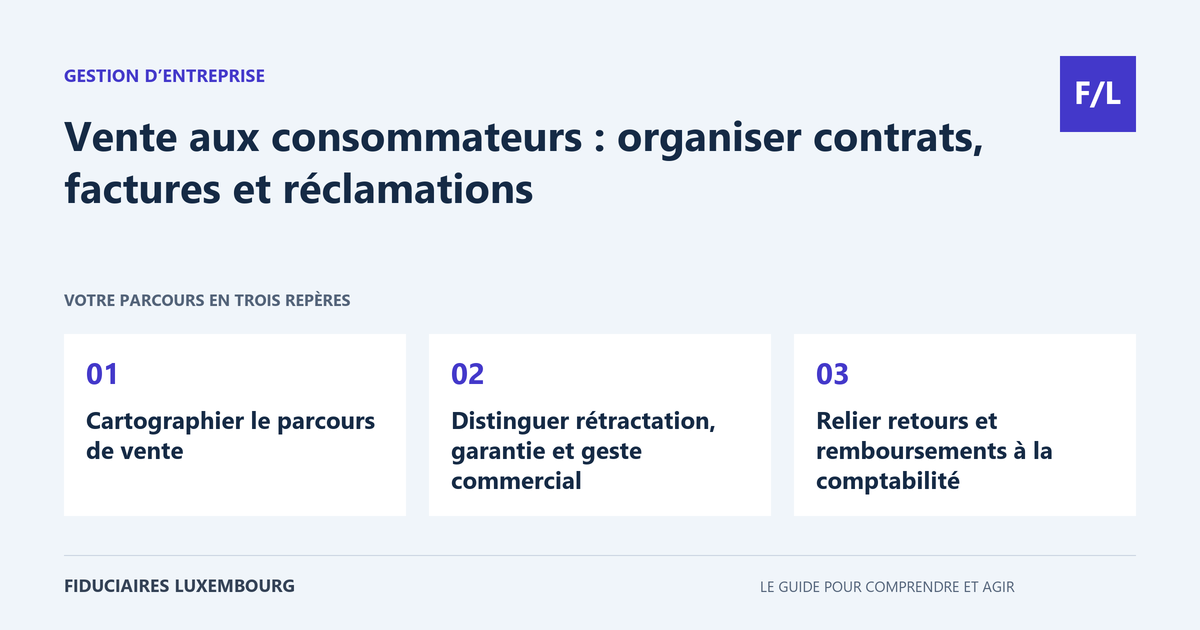
Mapping the sales journey
Describe what the customer sees before placing an order: the seller's identity, characteristics, price, charges, payment and performance. For a distance sale, review the information and confirmation obligations provided for under the official process.
The contract, product page, checkout process and emails must say the same thing. An amount displayed without clearly explained charges may give rise to disputes, even if the final invoice is calculated correctly.
Distinguishing withdrawal, guarantee and commercial gesture
These mechanisms do not have the same basis or the same conditions. Time limits, exceptions and procedures must be reviewed according to the product, service and channel. Avoid using a single clause copied from another sector.
Prepare responses with competent advice and the people responsible for customer service. An amicable exchange must not conceal the nature of the right relied upon. Keep the versions of the terms accepted and proof of confirmation.
Linking returns and refunds to accounting
Each cancellation, credit note or refund must be capable of being matched to the original sale. Define the documents to be produced, the checks before payment and the treatment of VAT.
If you use a marketplace or payment service provider, reconcile sales, commissions, refunds and amounts actually received. A net payment is not the gross amount of your sales. This distinction is essential for understanding the margin.
Making complaints a management indicator
Classify the reasons: product, delivery, price, information or invoicing. Identify recurring problems and their cost. A monthly table can link return rates, charges and operational corrections.
The accounting firm helps organise flows and supporting documents; validating contractual terms and consumer obligations requires appropriate legal expertise. Assign these roles before launching the sales channel.
Testing an order from the customer's perspective
Choose a representative product or service and go through the steps as a new customer. Before payment, the characteristics, total price, charges and terms must be understandable. The final button must unambiguously indicate the commitment to pay. Ask legal counsel to review the texts and their placement in the actual customer journey.
After the order, check the confirmation and retention of information on a durable medium. Keep the version of the terms associated with the sale. A link pointing only to a page that you can modify does not, on its own, make it possible to retrieve what the customer received and accepted when placing the order.
Withdrawal is in principle subject to a fourteen-calendar-day period for relevant distance contracts, with a starting point and exceptions to be reviewed depending on the sale. Have personalised goods, services that have started and digital content reviewed separately. A ticked box does not allow a statutory right to be freely removed.
Tracking a refund through to the bank statement
In a fictional example, an order that has been collected is then partially cancelled. Customer service must provide the sales reference, the reason, the items concerned and the approved amount. Accounting prepares the appropriate document, then the payment is matched to the correction. The guide on the credit note and corrective invoice explains this traceability.
If the platform pays a net amount, reconstruct the details: sales, commissions, deductions and refunds. A reduction in the transfer does not prove an equivalent decrease in turnover. Use bank reconciliation to link movements to transactions, while keeping the payment service provider's reports.
When you sell to private individuals in several countries, add the VAT classification to the file. The OSS scheme addresses certain tax obligations; it does not replace consumer protection rules. Prepare a complaints procedure that distinguishes delivery issues, lack of conformity, withdrawal and commercial gestures. This distinction makes it possible to provide the right response and analyse the cost of incidents without grouping them together under a single heading.
| Stage | Useful evidence | Person to appoint |
|---|---|---|
| Order | Sales information and terms | Sales or e-commerce team |
| Confirmation | Document provided and version retained | Customer journey manager |
| Complaint | Request, classification and response | Customer service with advice where necessary |
| Correction | Credit note, refund and reconciliation | Accounting and the person authorising payment |
Let's consider a practical case
Fictional educational example, intended to explain the reasoning.
A small business launches an online shop. It has the information about the seller, price, delivery and applicable terms reviewed, then tests the screens and confirmations sent. The review also covers proof of consent and the handling of a complaint. Copying terms from another sector risks introducing unsuitable commitments. The text and the shop's actual operation must be capable of being explained together.
Points to prepare
- Customer and sales channel identified.
- Pre-order information and confirmation are consistent.
- Returns, credit notes and refunds are traceable.
- Contractual terms reviewed.
Frequently asked questions
Are a credit note and a refund the same thing?
No. The credit note corrects the invoicing; the refund corresponds to the financial movement. Both must be reconciled where necessary.
Can the same terms cover all sales?
Customers, channels and product categories must be distinguished. Adaptation may be necessary.
Useful terms in this guide
Questions to ask the professional
- Which rules apply to my product and my method of sale?
- What evidence should be retained of the order and the information provided?
To clarify the scope of your request, also consult our company formation section.
And for your situation?
Prepare screenshots of the order journey, your confirmations and an example of a customer return. Have the contractual obligations reviewed by competent counsel and ask your accounting professional to organise the record of sales and refunds. Search our directory for the professional suited to your needs, then ask them for an engagement and a detailed quote.
Sources and verification
References consulted on 20 September 2026. Official procedures specify the applicable conditions and exceptions.
This guide explains a general process. The applicable rules depend on your situation; it does not constitute personalised advice. Report a correction.
Your next step
A specific need deserves the right contact
Accounting, taxation, company formation or payroll: prepare your questions, then search the directory for the professional who can review your situation. Check their assignments and status before entrusting them with your file.