The SARL-S can facilitate certain projects, but its reduced capital is only one element of the decision. Also consider the eligible shareholders, the planned activity and the financing required to operate after incorporation.
The SARL-S is reserved for natural persons. Its capital may start at €1 and it may be incorporated under private seal; very low capital does not finance operations.
The framework to review
The SARL-S is a regulated legal form, with its own restrictions. Its conditions are not limited to the minimum capital. Authorisations, contractual commitments and accounting and tax obligations must still be reviewed for the project.
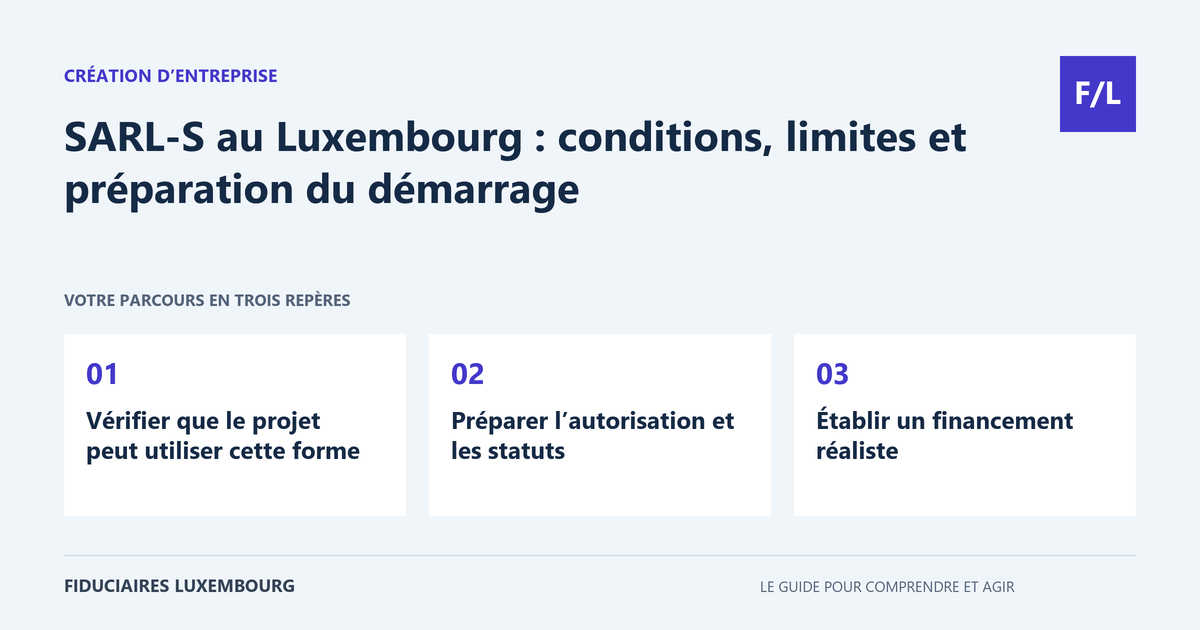
Check that the project can use this form
The official information sheet sets out the permitted activities, conditions relating to shareholders and restrictions specific to this form. In particular, check the situation of a person who is already a shareholder in an SARL-S. Do not choose the structure solely because it appears less costly to incorporate.
If a company is to become a shareholder or if investors are expected soon, discuss the most appropriate form from the outset. Anticipating this issue can avoid a transformation shortly after launch.
Prepare the authorisation and articles of association
Identify the activity and the manager responsible for meeting its access requirements. The coordination between the business permit, incorporation and registration must be followed in accordance with the official process. A template for articles of association is a starting point to adapt, not a complete analysis of the project.
Clarify the registered office, powers, allocation of shares and decision-making rules. If several shareholders are involved, address disagreements, the departure of one of them and additional financing. The absence of mandatory notarial involvement in an incorporation under private seal does not remove the need to understand the signed instrument.
Establish realistic financing
Capital and the cash flow required for the activity are not the same thing. List the expenses to be paid before the first sales: equipment, tools, insurance, services and possibly salaries. Add a reserve for late receipts.
Document the shareholders’ contributions or advances and their treatment. The rules on reserves and capital changes specific to the SARL-S must be incorporated into the monitoring; have their application to your situation confirmed rather than using an isolated amount found in an article.
Manage the company after its creation
Organise accounting, VAT, registrations and filing of accounts in accordance with the applicable obligations. Simplified incorporation does not mean that accounting follow-up is optional. Assign the procedures and keep evidence that they have been completed.
Review the structure when the activity, financing or shareholding changes. Any transformation must be prepared with its legal, administrative and financial effects. It should not be decided solely on the basis of turnover.
Check the criteria before preparing the documents
According to Guichet.lu, SARL-S capital ranges from €1 to €12,000 and must be fully subscribed and paid up upon incorporation. Shareholders must be natural persons. In principle, the same person may not be a shareholder in several SARL-S entities at the same time, except for shares received as a result of death. These criteria must be reviewed for all participants.
Draft a specific description of the activity, then check its eligibility and the requirements for the authorisation. A vague business description is not sufficient to prepare the application. The guide to the business permit makes it possible to distinguish the company's documents from the conditions relating to the manager.
If a corporate investor is expected to become a shareholder shortly, compare the project now with the incorporation of an SARL. The cost of a legal form is not limited to the first invoice: add the adjustments required for the planned development.
Build the budget for the first few weeks
Imagine a hypothetical activity that must pay €2,000 for equipment, €900 in start-up costs and €1,100 in expenses before the first receipt. In this scenario, €4,000 in outflows must be financed, even if the selected capital is much lower. This calculation is a cash-flow example, not an incorporation fee or a capital recommendation.
Specify the source of each resource: capital contribution, shareholder advance or external financing. The shareholder current account requires clear terms. An amount temporarily available should not be presented as a permanent resource if its repayment jeopardises the start-up.
Then follow a thirteen-week cash-flow plan. Test a first customer payment received later than expected and decide what reserve to keep. From the first transactions, separate company expenses from personal payments, file supporting documents and assign the declarations. The simplicity sought at the outset should be reflected in an organisation that is easy to understand on a day-to-day basis. Schedule an initial review with the firm after the first invoices to quickly correct practices that would complicate closing.
| Area | To prepare | Useful check |
|---|---|---|
| Shareholders and activity | Identities, shareholdings and precise description | Eligibility of the form and authorisation |
| Capital | Amount and nature of contributions | Subscription and payment up |
| Operations | Budget and documented resources | Payments possible before receipts |
| Administration | Articles of association, access and timetable | Person responsible for each obligation |
Let us consider a practical case
Fictitious educational example intended to explain the reasoning.
A person launches a service activity with little equipment. Even if the initial capital is low, they must finance insurance, software, administrative costs and the payment period of the first customers. They therefore compare the forms in light of their resources and the planned development. If the future entry of a shareholder or investor is planned, they check the consequences now. An accessible incorporation must be accompanied by a viable operating model.
Points to prepare
- Activity and eligible shareholders verified.
- Authorisation and registration coordinated.
- Articles of association understood and adapted.
- Operating budget separate from capital.
Frequently asked questions
Does incorporating with €1 mean starting with €1?
No. Cash-flow needs and expenses still need to be financed even where the minimum capital is very low.
Does the SARL-S exempt a company from annual accounts?
No. The applicable accounting and filing obligations must be organised from the start.
Useful terms in this guide
Questions to ask the professional
- Am I eligible for this form given my activity and shareholders?
- What financing should be planned for the first few months?
To clarify the scope of your request, also consult our company formation information.
And for your situation?
Before choosing the SARL-S, prepare the list of shareholders, the exact activity and the budget for the first few months. Ask the professional to compare this form with your financing needs and planned development. Search our directory for the professional suited to your needs, then ask them for an engagement and a detailed quote.
Sources and verification
References consulted on 20 September 2026. Official procedures specify the applicable conditions and exceptions.
- Guichet.lu — société à responsabilité limitée simplifiée
- Guichet.lu — autorisation d’établissement
- Guichet.lu — dépôt des comptes annuels au RCS
This guide explains a general process. The applicable rules depend on your situation; it does not constitute personalised advice. Report a correction.
Your next step
A specific need deserves the right contact
Accounting, taxation, company formation or payroll: prepare your questions, then search the directory for the professional who can review your situation. Check their assignments and status before entrusting them with your file.