Setting up an SARL is easier to manage when you separate decisions from formalities. Before gathering signatures, clarify the activity, the partners, the powers and the start-up financing.
A standard SARL requires minimum capital of €12,000 and a notarial deed. The capital does not represent the total budget needed to start the activity.
The framework to check
The SARL is a legal form with its own rules, including minimum capital. Professional authorisations, tax obligations and the identification of beneficial owners remain separate matters. Limited liability does not mean that no personal commitment is possible.
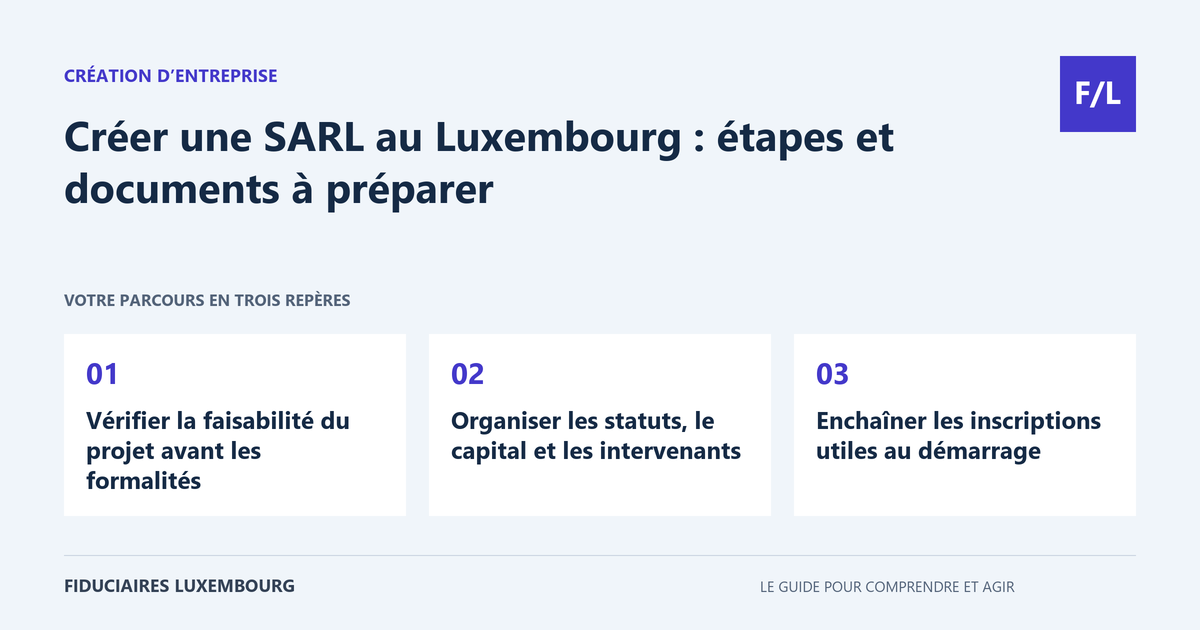
Checking the feasibility of the project before formalities
Describe the planned activity and its customers, then check whether it requires a business permit or specific approval. The SARL form does not exempt you from the conditions specific to the profession. Clarify who will effectively manage the business and where the work will be carried out.
Prepare a cash-flow estimate distinguishing capital, financing, start-up expenses and recurring costs. Rent, insurance, tools, fees and initial salaries may be due before the first income. Also compare alternatives with a professional before choosing a company form.
Organising the articles of association, capital and parties involved
The articles of association determine, in particular, the purpose, registered office, partners and operating rules. Prepare the identity of the parties, the allocation of capital, signing powers and information on beneficial owners. Partners should also discuss entry, exit and the settlement of disagreements.
Coordinate the requirements of the notary and the bank before setting a signing date. The banking process includes its own checks; no universal timeframe can be promised. If contributions or persons established abroad are involved, report them from the outset.
Completing registrations useful for starting up
After incorporation, follow up on registration with the RCS and publication formalities. Review obligations relating to the register of beneficial owners. Depending on the activity, arrange VAT registration, social security affiliations and employer formalities.
Assign a person responsible for each procedure and retain acknowledgements of receipt. An application filed, an authorisation granted and a completed registration are different statuses. Before invoicing, check that the conditions necessary to carry out the activity are actually met.
Preparing the first month of operations
Set up document filing, invoice numbering, bank access and exchanges with the fiduciary. Provide for a separate file for expenses incurred before incorporation, to be reviewed for their treatment.
Request a schedule of the first returns and a review point after launch. It should make it possible to identify incomplete invoices, unsigned contracts, authorisations still pending and cash-flow gaps. This organisation reduces costly rework at the first closing.
Hold a decision-making meeting before the incorporation appointment
Bring the future partners together around a few practical topics: contributions, allocation of shares, management, intended remuneration and financing needs. Write down what has been decided and what remains open. An oral agreement on each person’s role can conceal different expectations regarding working time or important decisions.
Prepare for situations that may change: a new investor, a partner’s departure, a disagreement or additional financing. The guide to the transfer of SARL shares helps anticipate transfer-related questions; the guide to capital increases explains the documents useful for a change in financing.
Distinguish what must be addressed in the articles of association, in another agreement or in an employment or service agreement. Have these documents coordinated by the competent parties. Signing the deed of incorporation does not automatically settle ownership of software, a trademark or another asset used by the company.
Building a start-up file that you can actually follow
Use a table with four columns: procedure, person responsible for follow-up, status and evidence. Add dependencies between procedures. The business permit file is prepared in line with the conditions of the activity; the RCS and the RESA relate to separate registration and publication formalities.
For the register of beneficial owners, gather the organisational chart and control-related information, including indirect control. Do not limit the analysis to the manager’s name. Where another company is among the partners, explain the chain through to the natural persons concerned and have the applicable criteria checked.
Before the first month of invoicing, check access rights, document templates and responsibilities. The guide to VAT registration helps prepare the first transactions; the cash-flow plan tracks expenditure and receipts. Choose a review date after start-up to examine procedures still open, the first supporting documents and budget variances. This review makes problems visible while they are still easy to correct.
| Subject | Decision or preparation | Expected evidence |
|---|---|---|
| Partners | Contributions, shares and powers | Appropriate deeds and agreements |
| Activity | Access conditions and manager | Required authorisation obtained |
| Registers | Data and persons to declare | Applicable acknowledgements and publications |
| Operations | Invoicing, accounting and financing | Operational file and schedule |
Let us consider a practical case
Fictitious educational example intended to explain the reasoning.
Two partners finance an SARL and plan to rent premises. They must plan for the capital, but also the security deposit, equipment and the first months of operation. They also consider who can sign the lease and whether a personal guarantee is requested. This preparation sometimes reveals that a budget exceeding the minimum capital is necessary. Incorporation can then form part of realistic financing and an authorisation timeline, rather than precede essential decisions.
Points to prepare
- Activity, authorisations and establishment location checked.
- Partners, managers and beneficial owners identified.
- Draft articles of association, financing and timeline coordinated.
- Accounting, VAT and social security obligations prepared.
Frequently asked questions
Can everything be set up remotely?
Some procedures may be electronic or carried out by a representative. Identification, signature and actual establishment requirements must still be met.
Does the capital cover incorporation costs?
Capital is a resource of the company. Costs and the financing needed for operations must be budgeted separately.
Useful terms in this guide
Questions to ask the professional
- What budget should be planned in addition to the capital?
- Who is responsible for each formality after the articles of association are signed?
To clarify the scope of your request, also consult our company formation file.
What about your situation?
Present the parties involved with a shared file: activity, partners, financing and desired timetable. Ask who is responsible for each step, then keep track through the first transactions and returns. Search our directory for the professional suited to your needs, then ask them for an engagement and a detailed quote.
Sources and verification
References consulted on 20 September 2026. Official procedures specify the applicable conditions and exceptions.
- Guichet.lu — société à responsabilité limitée
- Guichet.lu — autorisation d’établissement
- Guichet.lu — immatriculation et publications au RCS
- Guichet.lu — déclaration des bénéficiaires effectifs
This guide explains a general process. The applicable rules depend on your situation; it does not constitute personalised advice. Report a correction.
Your next step
A specific need deserves the right contact
Accounting, taxation, company formation or payroll: prepare your questions, then search the directory for the professional who can review your situation. Check their assignments and status before entrusting them with your file.