You have developed an invention and wish to protect it? Let us start with the rights held, the target markets and the disclosure timetable. The filing should form part of a protection strategy and a budget that you can monitor.
A Luxembourg patent protects within Luxembourg territory. The filing strategy must correspond to the target markets and be reviewed before disclosure of the invention.
The framework to review
A patent, a trade mark and copyright protect different subject matter. Patentability and ownership of rights require specialist assessment. A national filing does not create worldwide protection, and legal protection guarantees neither an accounting value nor a tax advantage.
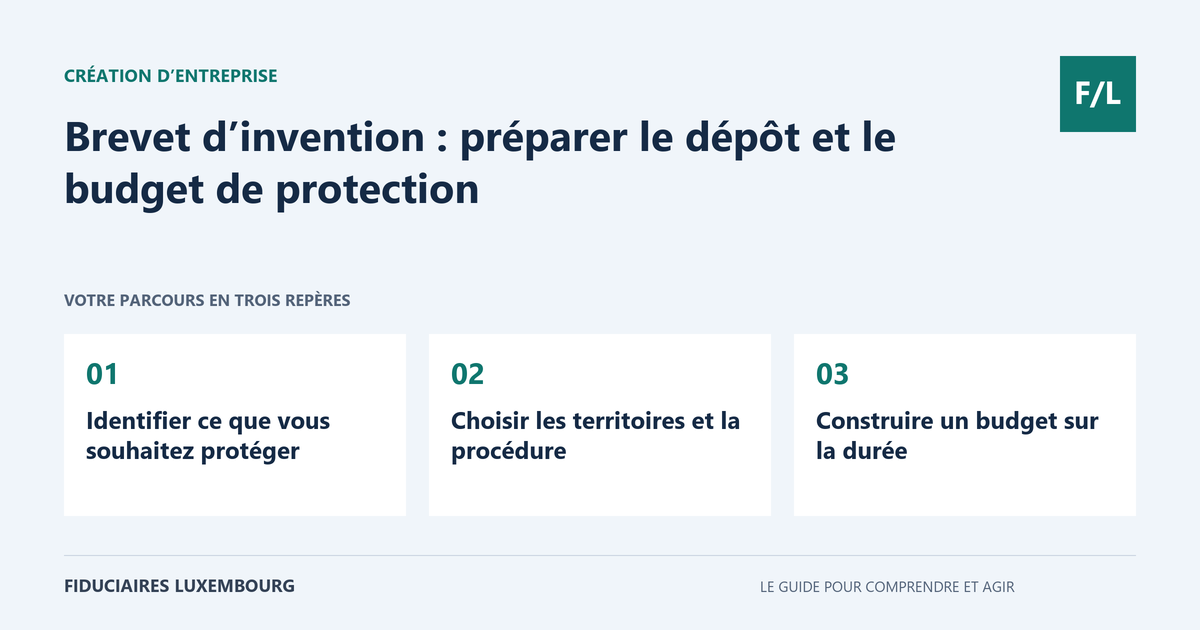
Identify what you wish to protect
Describe the technical solution and how it differs from what already exists. Distinguish between an invention, a commercial sign, the appearance of a product and know-how. These items do not fall under the same protection tool.
Before a public presentation or negotiation, review confidentiality with a specialist. Document the authors, employment or service contracts and ownership of the results. A development invoice alone does not prove ownership of all rights.
Choose the territories and procedure
The geographical scope is a strategic decision. Compare countries of marketing, manufacturing and plausible future markets. A national filing does not provide worldwide protection.
Request a timetable distinguishing the initial filing, any extensions, examination and formalities. Publication of an application, grant of a title and its contestable validity are different situations. The industrial property professional must explain the searches and the limitations of the analysis.
Build a long-term budget
Allow for fees, taxes, translations, extensions and maintenance of rights. The cost of the first filing is only one part of the budget. Guichet.lu states a maximum duration of twenty years from filing, subject in particular to annual fees; where there is no search report, the stated maximum duration is six years.
In the accounts, ensure that research, development, purchase of rights and protection costs are distinguished. The treatment of an expense and eligibility for aid or a tax regime must be justified separately. Legal protection does not automatically establish an accounting value.
Link protection to the business model
Describe how the invention will be exploited: sale of products, licensing or assignment. For each option, identify the contracts, revenue monitoring and responsibilities. A protected asset may generate no revenue if commercialisation is not prepared.
Regularly review the territories retained and the costs. The fiduciary helps monitor expenses and income; the industrial property adviser assesses protection. Have these parties work together using the same documentation.
Prepare the meeting before making the invention public
Prepare a working description: technical problem, proposed solution, tests carried out and differences from known solutions. List the persons who participated in development and the corresponding contracts. Attach the dates of presentations, publications or exchanges that have already taken place so that the specialist can assess the actual situation.
Do not confuse this preparation with drafting the claims. These define the protection sought and require specific expertise. The professional must also explain the difference between the possibility of obtaining a title and the risks relating to third-party rights when you exploit the product. Filing does not answer all commercial questions.
Guichet.lu specifies that national grant does not involve prior examination of patentability. This makes analysis of the file with a specialist adviser particularly useful. A filing certificate, a granted title and an assessment of its strength are documents whose scope must be distinguished.
Build a budget by decision, not only by invoice
Divide the project into stages: initial analysis, drafting and filing, possible extensions, maintenance and exploitation. For each stage, note the estimated cost, the decision to be made and the information required. A project that is still exploratory should not make future expenses invisible merely because the first fee is limited.
Also prepare how the rights will be exploited: use in your products, licensing to a third party or assignment. Contracts must specify the rights concerned and the economic terms. If the parties belong to the same group, the intra-group transactions file helps prepare pricing and substantiation questions, to be reviewed as appropriate.
In the accounts, classify costs by nature and by project with the corresponding supporting documents. The fixed asset register should not be automatically populated with every invoice related to an invention: have the treatment of expenses confirmed. In the forecast budget, keep revenue already contracted separate from that expected from future commercialisation. You will be able to reassess the relevance of each territory and maintenance expenses based on updated information.
| Area | Documents to gather | Decision to prepare |
|---|---|---|
| Technical | Description, tests and known solutions | Potential protection and useful searches |
| Rights | Contributions and contracts | Ownership and required authorisations |
| Territories | Markets and commercial timetable | Relevant filing and extensions |
| Budget | Costs by stage and anticipated revenue | Funding, treatment and maintenance |
Let us look at a practical case
Fictitious educational example, intended to explain the reasoning.
A company develops a technical device and plans to present it at a trade fair. Before this presentation, it consults a specialist on confidentiality, potential protection and deadlines. It also prepares the contracts of the persons who participated in development. The accounting firm helps it distinguish expenses already incurred from the future budget: filing, possible extensions and maintenance. This preparation links the commercial timetable to protection, rather than discovering the constraints after disclosure.
Points to prepare
- Protected subject matter and right holders identified.
- Disclosure and confidentiality reviewed.
- Territories and filing timetable defined.
- Maintenance budget and exploitation planned.
Frequently asked questions
Does a trade mark replace a patent?
No. A trade mark distinguishes, in particular, products or services; a patent protects an invention under its own conditions.
Does a Luxembourg filing provide protection everywhere?
No. Protection is territorial; other countries require an appropriate strategy and procedures.
Useful terms in this guide
Questions to ask the professional
- What subject matter should be protected, in which territories and before what disclosure?
- What contracts, supporting documents and maintenance costs should be planned?
To clarify the scope of your request, also consult our taxation section.
And for your situation?
Before a public presentation, seek advice on protection and confidentiality. For financial monitoring, prepare a budget by stage and ask an accounting professional to work from the same documents as your industrial property adviser. Search our directory for the professional suited to your needs, then ask them for an engagement and a detailed quote.
Sources and verification
References consulted on 20 September 2026. Official procedures specify the applicable conditions and exceptions.
This guide explains a general process. The applicable rules depend on your situation; it does not constitute personalised advice. Report a correction.
Your next step
A specific need deserves the right contact
Accounting, taxation, company formation or payroll: prepare your questions, then search the directory for the professional who can review your situation. Check their assignments and status before entrusting them with your file.