The tax return is best prepared when you first know who is filing, for which period and with which authority. This framework prevents you from discovering too late that a payment or accounting filing does not replace the required tax return.
Identify the entity, financial year and each relevant tax. A company’s deadlines and forms must not be confused with those of its director.
The framework to verify
Individuals and companies do not necessarily fall under the same tax returns. Direct taxes, VAT and social security contributions follow separate procedures. Deadlines must be checked for the relevant return and financial year, as well as in light of communications received.
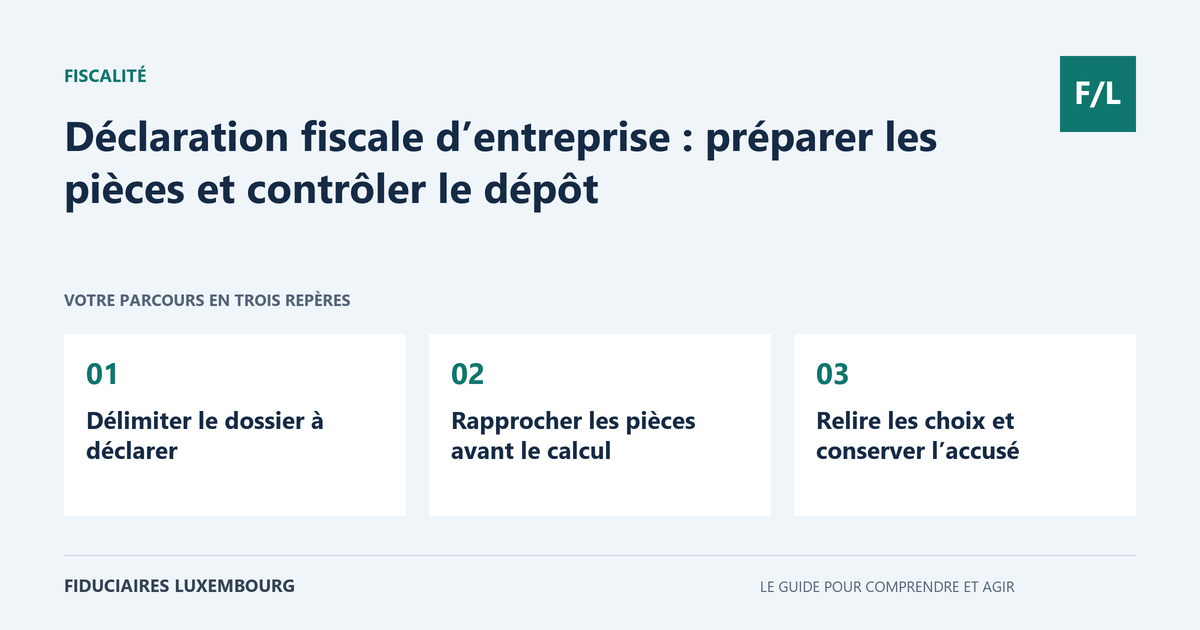
Define the file to be declared
Check the legal form, tax residence, accounting period and events of the financial year. Incorporation, liquidation, a change of activity or a foreign transaction may alter the file. List the authorities’ requests and the obligations already monitored by another party.
For a company limited by shares, the official assistant distinguishes information relating to the relevant taxes. Use the appropriate tax year and check the applicable deadline; an article title mentioning a year does not constitute a tax calendar.
Reconcile documents before the calculation
The file must make it possible to move from the accounts to taxable income. Gather the annual accounts, trial balance, details of fixed assets, financing, provisions and specific transactions. Note any private expenses, transactions with shareholders and foreign items.
Prepare a table of outstanding questions: amount, missing supporting document, person responsible and expected date. Important oral answers should be confirmed in writing. An estimate must be identifiable as such and must not be confused with an invoice or an assessment obtained.
Review the choices and keep the acknowledgement
Request a summary of significant adjustments, assumptions and points to be confirmed. Check consistency between the return, approved accounts and retained documents. Arrange validation by the authorised person before submission.
After filing, archive the submitted version and its acknowledgement of receipt. The fact that a form is technically accepted does not mean that the authorities have validated all tax treatments. When an assessment notice arrives, reconcile it with the expected calculation and have any discrepancies reviewed promptly.
Monitor changes after filing
A late invoice, a discovered error or a letter from the authorities must be reported to the person responsible for the file. Do not amend declared data without retaining the history. Correction options and objection deadlines depend on the situation.
At the closing meeting, draw practical conclusions for the following financial year: better monitoring of documents, more frequent reconciliations or cash-flow forecasting for payments. Filing ends one stage, not tax monitoring.
Take an inventory of taxes and expected evidence
Open a record for each obligation with the entity, period, form, source of the deadline and responsible person. Attach communications received from the authorities. If one firm handles the company and another handles the director, explicitly identify the boundary between their engagements. A family file cannot be inferred from the company’s file.
For a company, the guides on IRC, municipal business tax and net wealth tax help prepare separate questions. The VAT file follows yet another procedure. The purpose of this list is to make each step visible, even when several items of information are brought together in a single filing assistant.
Separate advance payments made from estimated tax and the expected balance. Adequate cash flow on the filing date does not guarantee that subsequent payments are covered. Reconcile notices, payments and calculations to explain amounts without counting them twice.
Organise the final review around the points that change the result
Request a reconciliation table from the accounts to taxable income. For each significant adjustment, record the transaction, supporting document and position adopted. Tax losses carried forward must be monitored by financial year; fixed assets require a consistent history of movements and depreciation.
In a fictional example, a provision appears in the accounts while a requested supporting document is still missing. The director must know the issue to be resolved and its potential effect before approving the tax return. It is not enough to receive a final tax amount without being able to identify the points explaining its change.
Upon receipt of an assessment notice or a request for information, centralise the document with the relevant tax return. Record the date of receipt and have the necessary follow-up reviewed without waiting for the next annual meeting. The next closing preparation can incorporate lessons from the file: documents to obtain earlier, a better distinction between expenses and more regular monitoring of specific transactions. This organisation facilitates the work of all parties involved and reduces late searches.
| Status | Evidence | Next action |
|---|---|---|
| In preparation | Documents and outstanding questions | Complete and document the tax treatments |
| Approved for filing | Reviewed version and required approval | Submit through the authorised person |
| Filed | Tax return and acknowledgement | Monitor requests and payments |
| Decision received | Assessment notice and date of receipt | Reconcile and review follow-up actions |
Let us look at a practical case
Fictional educational example, intended to explain the reasoning.
A company has filed its annual accounts and its director believes the administrative file is complete. However, the director reconciles the completed formalities with the tax calendar: certain tax returns still need to be prepared, with their own documents and approvals. The director also distinguishes instalments already paid from the balance resulting from the processing of the file. This overall view makes it possible to anticipate cash flow and find evidence of each step without confusing them.
Points to prepare
- Entity, financial year, forms and deadlines identified.
- Accounts and adjustments reconciled.
- Approval of the final version obtained.
- Acknowledgement and correspondence monitoring retained.
Frequently asked questions
Does an accepted filing confirm the tax calculation?
No. The acknowledgement confirms submission; tax review and assessment are separate stages.
Must the director’s personal income also be declared?
It is covered by a separate file. Check explicitly whether this service is included in the engagement letter.
Useful terms in this guide
Questions to ask the professional
- Which tax returns specifically concern my structure?
- Who monitors requests for information and decisions received?
To clarify the scope of your request, also consult our taxation section.
And for your situation?
Gather your accounts, tax notices, payments and unusual transactions before the tax meeting. Request an engagement specifying the included tax returns, validation and monitoring of correspondence after filing. Search our directory for the professional suited to your needs, then ask them for an engagement and a detailed quotation.
Sources and verification
References consulted on 20 September 2026. Official procedures specify the applicable conditions and exceptions.
This guide explains a general process. The applicable rules depend on your situation; it does not constitute personalised advice. Report a correction.
Your next step
A specific need deserves the right contact
Accounting, taxation, company formation or payroll: prepare your questions, then search the directory for the professional who can review your situation. Check their assignments and status before entrusting them with your file.